
Impulse Control Lost Me More Money Than Bad Setups Ever Did
Your strategy might be fine. Trading psychology determines whether it survives contact with your own nervous system. Here’s what that looks like in practice.
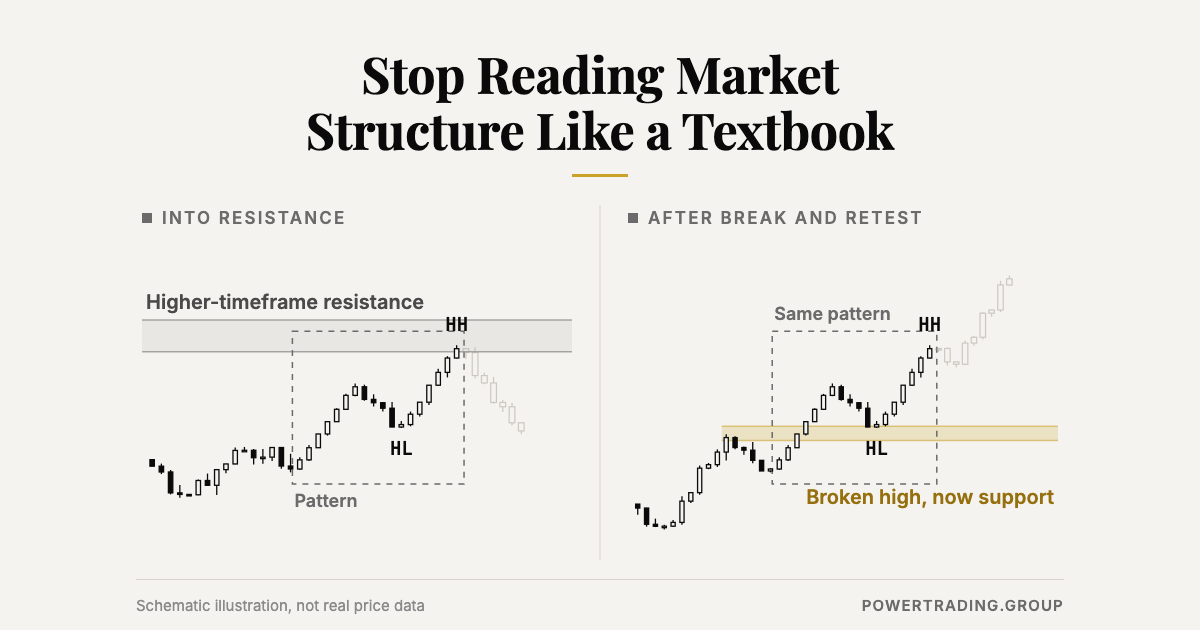
Stop Reading Market Structure Like a Textbook
Most market structure education teaches you what price has done, not where it’s doing it. Location changes everything about whether a structural pattern actually has edge.
PTG StatMap Tells You What Kind of Day You Are Trading Before the Open
Before I mark a single level, I read the tape. PTG StatMap formalizes that backdrop read, validated across 11.5 years of NQ data, and locks it before the open.
Setups Are Cheap. Location Is the Edge.
Every trader has the same pullback entry. The same reversal candle. The same breakout continuation. What separates results isn’t the pattern. It’s where the pattern fires.
Support and Resistance: The Foundation Every Serious Trader Needs to Master
Support and resistance is the first thing I check every morning before the market opens. Here’s how to stop drawing lines and start actually trading the levels.
Stock Market Mentorship: What It Actually Takes to Find One Worth Your Time
Most trading mentorships fail for the same reason: they give you signals instead of teaching you to think. Here’s what real stock market mentorship looks like.
VPOC Trading Strategy: How to Use the Volume Point of Control
VPOC marks where the most volume traded in a session. Here's how to build a real trading strategy around it, including how to combine it with the full volume profile.

Bid Size vs Ask Size: What Every Trader Needs to Know
Bid size and ask size tell you exactly how much the market wants to transact at current prices. Here's what they mean and how to use them.
Balance, Imbalance, Acceptance, Rejection: The 4 Market States Every Trader Must Read
The market cycles through 4 distinct states: balance, imbalance, acceptance, and rejection. Learn to read them and you stop predicting, start observing.

Trading Accountability: Why You Keep Breaking Your Own Rules (And How to Stop)
Willpower isn’t your problem. The structure around your trading is. Here’s why accountability works differently in trading and what actually makes the rules stick.
The Spring Trading Setup: A Complete Wyckoff Guide to Identifying and Trading Reversals
The spring trading setup is one of the most powerful Wyckoff reversal patterns - and one of the most misunderstood. Here's exactly how to identify and trade it.
How to Read a Nasdaq Futures Chart: A Practical NQ Analysis Guide
Most traders find a Nasdaq futures chart and immediately look for signals. Here’s what they’re missing: how to actually read one.
NQ Futures: The Complete Guide to Trading Nasdaq-100 E-Mini Contracts
NQ futures are the instrument serious day traders gravitate toward. Here’s everything you need to know - from tick values and contract specs to market structure and risk management.
What is RVOL in Trading? How to Use Relative Volume to Filter High-Probability Setups
Relative volume (RVOL) separates tradeable opportunities from time-wasting chop. Learn how to use RVOL to filter high-probability setups with real NQ futures examples and avoid the 5 most common mistakes.
Institutional Reference Points in Futures Trading: The Levels Professional Traders Watch
Retail traders draw lines on charts. Professional traders trade around reference points where billions shift hands. Learn the 4 levels that actually dictate market movement.
Why Do Most Traders Fail to Read Market Structure? (The 4-State Framework)
Most traders see patterns. Professionals see market states. The difference between balance, imbalance, acceptance, and rejection is the edge you’ve been missing.

Stop Catching Falling Knives: The Right Side of the V Trading Framework
Ever bought a stock or index right before it gave another leg lower? Learn the Right Side of the V framework - a simple concept that helps traders stop catching falling knives and start waiting for proper confirmation before entering trades. Discover 3 proven scenarios for better timing and risk management.

The Emperor's New Indicators: Why ICT Trading Concepts Are Just Rebranded Market Principles
Are ICT trading concepts truly innovative, or just classic market principles with new names? This article reveals how the Inner Circle Trader methodology repackages established trading wisdom like Wyckoff theory while adding unnecessary complexity that prevents consistent results. Discover a simpler path to trading success.
Reading Market Conditions: A Professional Trader's Guide to Market Structure
Learn how professional traders identify optimal market conditions and adapt their strategies. Discover when to trade aggressively and when to step back from the markets.
Understanding Wyckoff's Market Phases for Informed Trading
By diligently applying Wyckoff's principles and analyzing trading range dynamics, traders can identify favorable opportunities and effectively manage risk, enhancing their prospects for success in the financial markets.