
The Spring Trading Setup: A Complete Wyckoff Guide to Identifying and Trading Reversals
The spring trading setup is one of the most powerful reversal patterns in technical analysis - and one of the most misunderstood. If you've been trading for any length of time, you've probably seen it play out without knowing what you were looking at. Price dips below a key support level, looks like a breakdown, and then snaps back hard. Traders who sold the breakdown get trapped. Smart money was accumulating the whole time.
That's the spring. And when you learn to recognize it correctly, it changes how you read the market.
I've been trading NQ and ES futures for over a decade. The spring setup comes up constantly in our daily sessions in the Trader's Thinktank - it's one of those patterns that works across timeframes, instruments, and market conditions. But most traders either miss it entirely or jump in too early and get burned.
This guide covers everything: what a spring actually is within the Wyckoff framework, how to identify it on any chart, how it differs from an upthrust, step-by-step trade execution, and the most common mistakes I see traders make. We'll also get into volume - because that's where most people fall short.
What Is a Spring in Trading? (Wyckoff Method Explained)
Richard Wyckoff developed his methodology in the early 1900s, and it's held up because it's built on market logic, not lagging indicators. At its core, Wyckoff describes markets as moving through four phases: accumulation, markup, distribution, and markdown.
The spring pattern occurs during the accumulation phase. Here's what's happening beneath the surface:
Institutional players - the "composite operator" in Wyckoff's language - need to build large positions without moving price against themselves. To do this, they need a pool of sellers. So they allow (or orchestrate) a brief push below an established support level. Retail traders see the breakdown and panic-sell or short. That selling pressure gives the institutions the inventory they want.
Then price reverses - sharply.
The spring got its name from the coiling action. Think of a spring being pushed down and then released. The further below support it dips, the more violent the reversal tends to be when it fires.
There are three variations of the spring:
Spring Type 1 - The most powerful. Price breaks support with volume, then reverses immediately on high volume absorption. Rare, but explosive.
Spring Type 2 - A moderate breach of support with mixed volume signals, followed by a test and reversal. This is what you'll see most often.
Spring Type 3 - A shallow penetration of support on low volume. Often precedes a weaker rally. More confirmation needed before entering.
For day trading purposes, Type 2 is your bread and butter. Clean enough to identify, frequent enough to trade regularly.
How to Identify a Spring Setup on Any Chart
Identifying the spring trading setup comes down to four core elements. You need all four - not three out of four.
1. An Established Trading Range
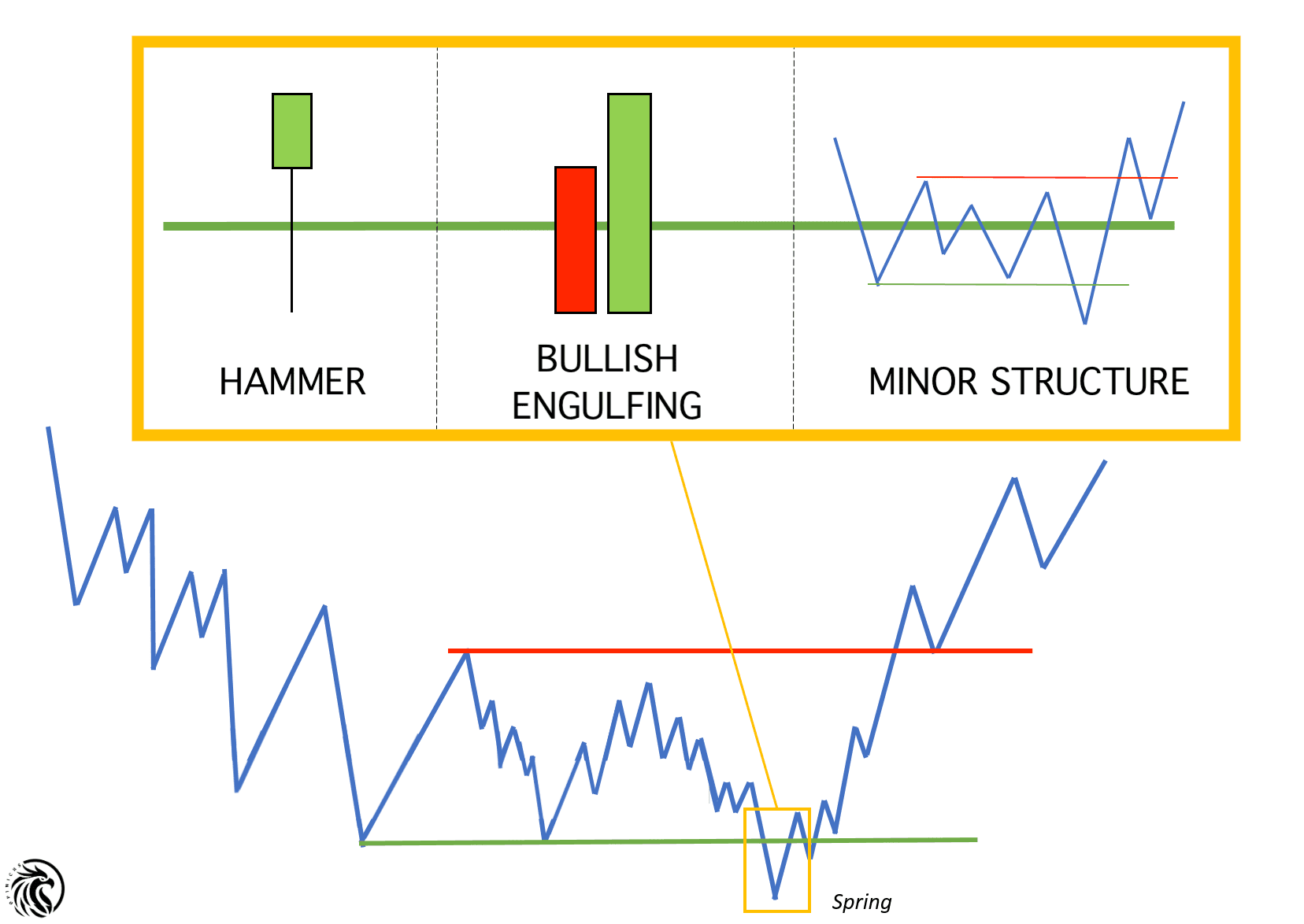
A spring doesn't happen in isolation. You need a clearly defined support level that has been tested multiple times. The more times price has respected that level, the more significant the spring will be when it occurs. I'm looking for at least two prior touches on the support before I start watching for a spring.
2. The Breach Below Support
Price needs to violate that support level - but not by much. This is the key. A legitimate spring penetrates support by a small margin. On NQ, I'm typically watching for a breach of 5 to 15 points below a clean support level on a 5-minute chart. Anything more than that and I start questioning whether it's a spring or a genuine breakdown.
The breach should also look and feel like capitulation. Rapid price movement, candles with long lower wicks, traders panicking out of longs.
3. Immediate Reversal
The reversal back above support needs to happen quickly. If price hangs below support for multiple candles, that's not a spring - that's a breakdown with a potential base building. A true spring snaps back inside the range within one to three candles on your working timeframe.
4. Volume Confirmation
This is where we'll spend more time in a later section, but you need to see volume tell the right story. The breach itself might come on moderate volume (the supply drying up) or on climactic volume (final flush). The recovery should show demand stepping in.
When all four elements align, you have a high-probability spring setup. Miss one of them and you're guessing.
Spring vs Upthrust - Key Differences
Understanding the spring-versus-upthrust distinction is essential for any Wyckoff trader. They're mirror images of each other, and confusing them is an expensive mistake.
The spring occurs at support during accumulation. Price pushes below a support level, traps sellers, then reverses upward. It signals the end of a bearish move and the beginning of markup.
The upthrust occurs at resistance during distribution. Price pushes above a resistance level, traps buyers, then reverses downward. It signals the end of a bullish move and the beginning of markdown.
Here's a side-by-side comparison:
Location in market cycle: Spring occurs in accumulation; upthrust occurs in distribution
What gets trapped: Spring traps sellers (shorts and panicked longs); upthrust traps buyers (breakout chasers)
Trade direction: Spring sets up long entries; upthrust sets up short entries
Volume behavior: Both show the same absorption dynamic - just in opposite directions
Psychological driver: Spring exploits fear of breakdown; upthrust exploits fear of missing a breakout
The pattern logic is identical. In both cases, the composite operator is engineering a false move to fill their book. Learn one and you essentially understand both.
I see a lot of traders who know the spring but haven't connected it to the upthrust. Once you see them as a pair, your read of the market at extremes gets significantly sharper. We cover both setups in detail inside the Trader's Thinktank - watching them develop in real time on NQ during live sessions is the fastest way to internalize the pattern.
Step-by-Step: How to Trade the Spring
Knowing the pattern is one thing. Executing it under live market conditions is another. Here's exactly how I approach a spring trade.
Step 1: Map Your Level
Before the session starts, I identify the key support levels on my trading instruments. These are the levels that have been respected multiple times - the ones that show up clearly on the chart. I'm not looking for arbitrary lines. I want confluence: prior swing lows, overnight lows, round numbers, VWAP interactions.
Step 2: Watch for the Setup
As price approaches that support level, I increase my attention. I'm watching how price is approaching the level - is it coming in on declining volume? Is there any sign of exhaustion on the selling side? I'm not looking to anticipate the spring. I'm waiting for it to reveal itself.
Step 3: The Breach
When price pushes through the support level, I don't react immediately. I watch. I want to see the character of the breach. Is it a clean, decisive push that reverses quickly? Or is price grinding lower and gaining momentum to the downside? The spring snaps back. The breakdown accelerates.
Step 4: Entry Trigger
My preferred entry is on the reclaim of the support level after the breach. I want to see price come back above the violated support and show some strength - ideally a candle that closes back inside the range. That's my trigger. Some traders prefer to wait for a test of the low (price comes back to retest the spring low on lower volume before launching), which gives a lower-risk entry but sacrifices some of the move.
For my personal framework, springs that form in the first 90 minutes of the regular session tend to set up the strongest intraday moves. That's the window I'm most focused on.
Step 5: Stop Placement
Stop goes below the spring low - not at it, below it. You need room for price to do what price does without stopping you out prematurely. On NQ, I'm typically giving it 8 to 12 points below the spring low depending on volatility at the time.
Step 6: Targets
The natural first target is the midpoint of the trading range. The full target is the upper boundary of the range (resistance). In many cases, the spring is the launch point for a larger markup phase, so if you're in a swing trade context, the ultimate target could be significantly higher.
Volume Confirmation - The Signal Most Traders Miss
Here's where I see most traders go wrong with the spring setup. They're watching price only. Volume is what separates a legitimate spring from a head-fake that continues lower.
During the breach below support, I'm looking for one of two volume signatures:
Climactic Volume (Selling Climax): A spike in volume on the candle(s) that push below support. This suggests the last of the sellers are being flushed out - exhaustion selling. When volume spikes dramatically on the violation of support and then price snaps back, that's the market telling you supply has been absorbed.
Dry Volume (No Demand on the Short Side): The opposite scenario - price slips below support on low volume. No one is aggressively selling. The move looks like a trap being set. When the reversal comes, the absence of sell-side conviction makes the spring even more reliable.
What you do NOT want to see: sustained, heavy volume below support without a quick reversal. That's not absorption - that's distribution. When sellers have the upper hand and volume confirms it, the move below support is real.
After the reversal begins, watch for volume to increase on the upside. Demand should be stepping in. If price is recovering on low volume, be cautious - the spring may lack the fuel for follow-through.
As Robert Onsomu shared about his time in our community:
"Prior to joining, I was a predictor and anticipator. I didn't have proper rules of engagement. Since joining, I have learned to be patient and actually learned to trade."
Patience is the core skill with the spring setup. You're waiting for the market to show you the setup - not forcing it.
Common Spring Trading Mistakes
I've watched hundreds of traders work through this pattern. These are the mistakes that show up most consistently.
Trading a Breakdown as a Spring
This is the most costly mistake. A genuine breakdown looks similar to a spring in the early moments - price violates support and there's uncertainty. The difference is in what follows. A breakdown picks up momentum below support. A spring snaps back immediately. If you're watching price grind lower for three, four, five candles below support, you're likely in a breakdown, not a spring. Wait for the reversal candle.
Entering Before the Reclaim
Some traders try to catch the exact low of the spring. They see price dip below support and immediately buy, thinking they've spotted the opportunity. The problem is that you don't know it's a spring until price comes back above support. Until that reclaim happens, you're buying into a potential continuation lower. Wait for the confirmation.
Ignoring the Broader Context
A spring trading setup in the context of a larger downtrend is significantly less reliable than one forming within a clear accumulation range in a neutral or bullish broader environment. Always zoom out before zooming in. If the daily chart shows price in markdown with no signs of accumulation, a spring on the 5-minute chart is a counter-trend trade with lower odds.
Misreading Volume
As covered above - volume confirmation matters. Trading the spring without volume context is like trading price action without reading the story the market is telling you. Study the volume signature every time you see a potential spring.
No Pre-Planned Levels
If you don't have the support level mapped before the market opens, you'll be identifying it in real time while price is already at it. That's reactive trading. Preparation is everything. Know your levels before the session starts.
"Unlike other gurus who may focus on trying to sell you indicators, Kyle has a singular focus on helping his members execute, with an emphasis on simplicity and discipline." - EH
Simplicity and discipline. The spring setup doesn't need an indicator to validate it. Price, volume, and structure tell you everything you need to know.
Real Chart Examples of Spring Setups
The spring pattern shows up on NQ almost every week. During our live sessions inside the Trader's Thinktank, we call these out in real time - identifying the potential setup as price approaches support, watching the breach, and then executing the reclaim entry together.
Recent examples from our live sessions have included:
NQ gapping down at the open to violate overnight support, then aggressively reclaiming the level within the first 15 minutes as volume dried up on the breach. Clean Type 2 spring that ran 40+ points.
ES hitting a multi-day support cluster on climactic volume in the first hour, snapping back with conviction. The spring low held perfectly and provided the entry for a range-target trade.
NQ testing a prior day low during the afternoon session on contracting volume, failing to accelerate lower, and reversing into a 25-point move into the close.
Seeing these patterns develop live is different from studying them after the fact. When you're watching it in real time and someone with experience is walking you through the thought process, the learning curve shortens dramatically.
For those using AutoPilot Trader, it's worth noting that the systematic logic embedded in the algorithm is built on these same price action foundations. The same institutional footprints that make the spring setup work manually are what APT is designed to capture automatically (APT currently trades the Two Hour Trader framework, but will be able to trade spring setups in Q2 of 2026).
"I've managed to double my port since joining the group and have finally found my stride." - Martin Chavez
FAQ
What is the spring setup in trading? The spring setup is a Wyckoff reversal pattern where price briefly penetrates below an established support level, traps sellers, and then snaps back above support - signaling the end of a bearish move and the beginning of an upward markup phase.
How do I know if a spring is valid? A valid spring requires: an established trading range with clear support, a brief and shallow breach below that support, an immediate reversal back inside the range, and volume confirmation showing either climactic exhaustion selling or low-volume (dry) movement on the violation.
What's the difference between a spring and a false breakout? They're related concepts. A spring is Wyckoff's specific term for a false breakdown at support in an accumulation range. A false breakout can refer to either direction. The spring implies institutional intent and specific volume characteristics - it's not just any false move below support.
How is the spring different from the upthrust? The spring occurs at support during accumulation and sets up long entries. The upthrust occurs at resistance during distribution and sets up short entries. They are mirror images - the same pattern logic applied in opposite directions.
What timeframe works best for spring trading setups? Springs form on all timeframes. For day trading NQ and ES futures, I focus primarily on the 5-minute and 15-minute charts. Higher timeframe springs (daily, weekly) tend to set up larger moves but require more patience in the trade.
Can the spring setup be used for prop firm challenges? Absolutely. The spring is a high-probability, defined-risk setup - exactly what you need when trading a prop firm evaluation. Clear entry, clear stop, clear target. That structure is ideal for maintaining the consistency prop firms require. It's one of the setups we focus on for traders working toward funded accounts.
The spring trading setup has been part of my core playbook for years. Get the pattern recognition down, add the volume reading, and then practice the patience to wait for the full confirmation. That combination is what separates traders who use this setup profitably from those who keep getting shaken out.
If you want to watch it develop in real time - live, on actual NQ charts, with full context - that's exactly what we do every trading day inside the Trader's Thinktank. The pattern makes a lot more sense when you're seeing it unfold in front of you.
And if you want to understand the broader Wyckoff framework this setup comes from, the Wyckoff method guide and the market structure breakdown are worth your time. The spring doesn't exist in isolation - it's part of a larger system for reading how markets actually move.