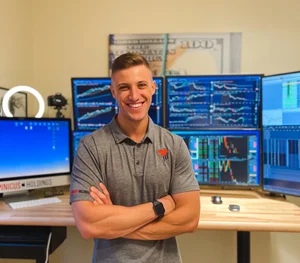
July 31st, NQ futures. Price ripped higher right off the open, the same way it had the day before, and I called out on the stream what usually comes next: "Anyone who missed it yesterday, starts chasing this morning just to get absolutely slammed. That's why I got to plan your trades. Never chase."
That chase reflex tells you everything about where most developing traders are stuck.
They think the move is the opportunity. They watch price accelerate away from them, feel the FOMO creeping in, and either chase it at the worst possible spot or write off the trade entirely. The actual opportunity, the pullback back into a defined area of value, barely registers as anything other than a reason for doubt.
I've been trading NQ for over a decade. Pullbacks are not a secondary event. They are the trade.
What a Pullback Is (And What It Isn't)
A pullback is a temporary counter-trend move within a larger directional move. Price is trending up, it retraces some of that gain, then continues in the original direction. In a downtrend, it does the opposite. That's the textbook version.
Here's the practical version: a pullback is price returning to an area where buyers or sellers previously showed up in force, giving you a defined spot to enter with a tight stop.
What a pullback is not is a sign that the trend is reversing. This is the core misread that costs traders money. They see price pull back 20-30 points on NQ and start asking whether the trend is broken. Most of the time, it isn't. It's just digesting the move before continuing.
The difference between a healthy pullback and an actual reversal comes down to structure. A pullback holds above the prior swing low in an uptrend. It does not break the structure that defined the original move. An actual reversal changes that structure. Price makes a lower low, momentum shifts, and the context of the market has genuinely changed.
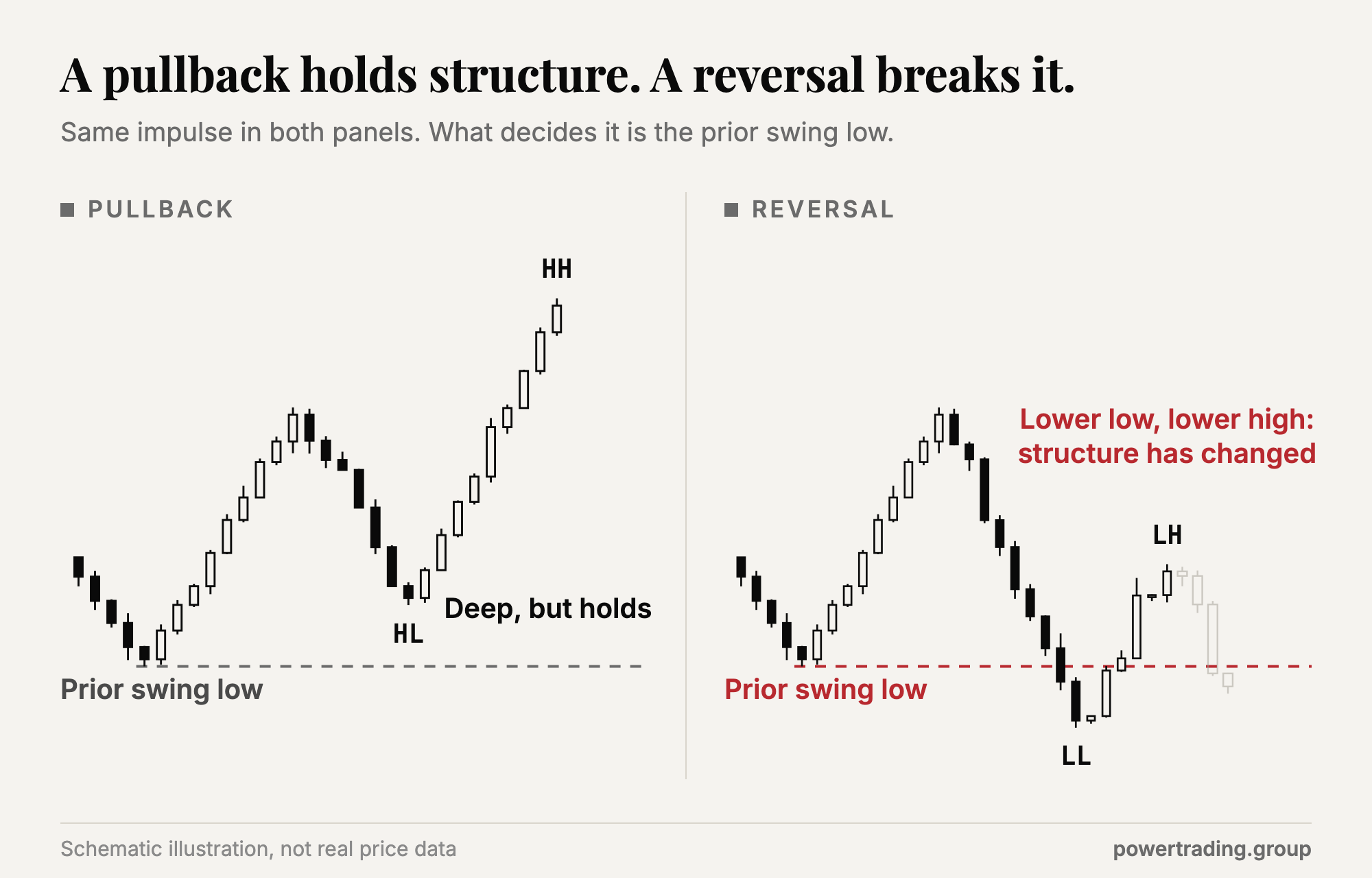
Until that happens, every pullback is a potential entry point for traders positioned correctly.
Why Pullbacks Work as Entries
The reason pullbacks produce better entries than chasing breakouts comes down to risk management. When you enter on a pullback, you're buying closer to a defined reference level. Your stop has a logical home. Your risk per trade is smaller. And because you're entering after the market has already demonstrated directional intent, you're not guessing which way it wants to go.
Compare that to chasing price after a breakout. You're entering extended, far from any meaningful support or resistance. Your stop has to be wider to survive the noise, which means your position size shrinks to keep risk constant. And if price pulls back at all, you're immediately underwater and questioning the trade.
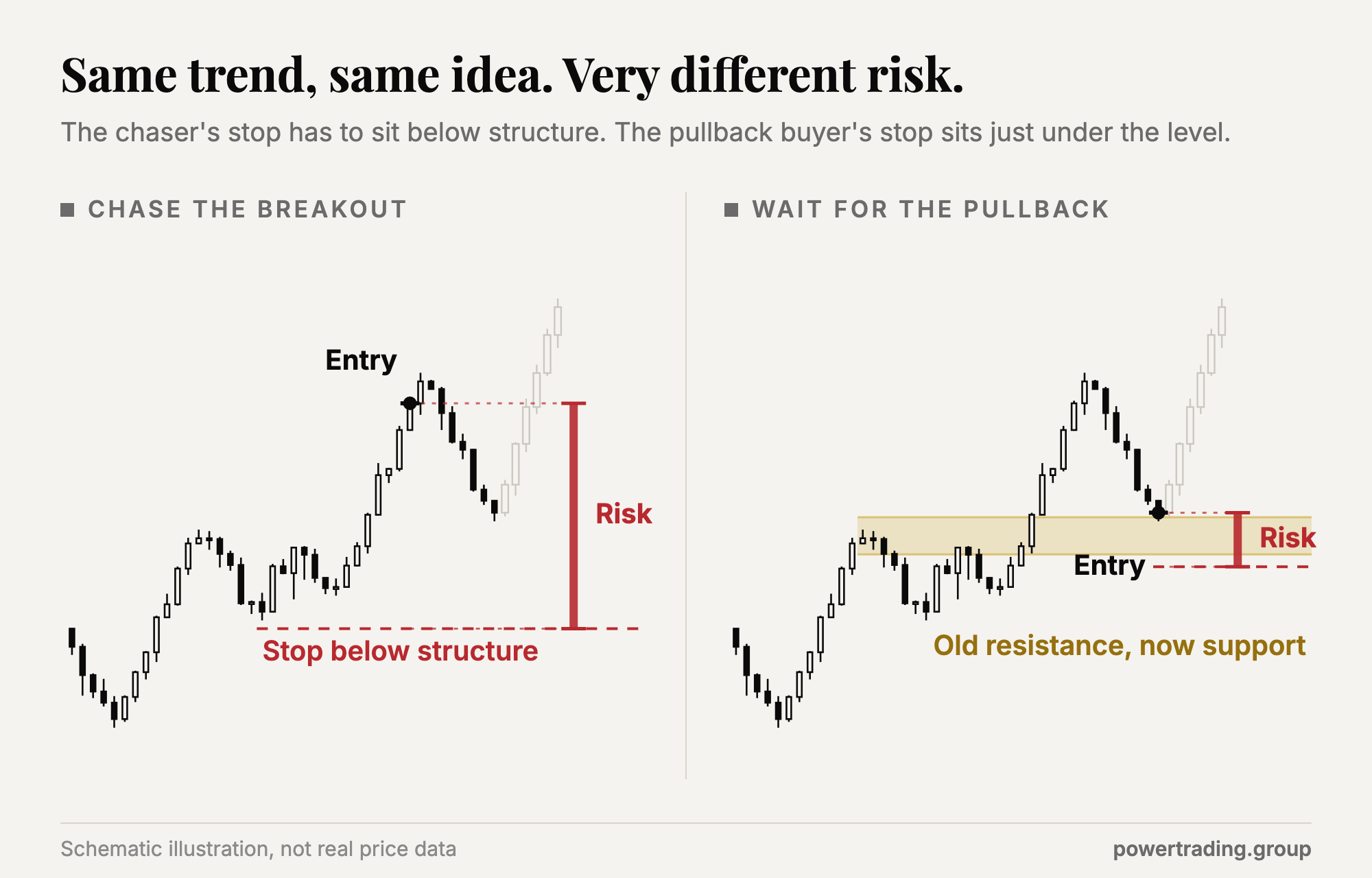
The math alone makes pullback trading superior, but the psychology is where it really separates itself. When you enter on a pullback into a level you planned ahead of time, there's no anxiety about "did I miss it." You either get filled at your spot or you don't. The discipline that creates is underrated.
In our Trader's Thinktank community, this comes up constantly in trade reviews. Traders who chase breakouts tend to have inconsistent results even when their directional reads are right. Traders who wait for the pullback to a planned level, even if they miss some trades that never retrace, almost universally show tighter average risk and more consistent execution.
The Transformation: From Chasing to Waiting
There's a specific shift that happens somewhere in a trader's development where they stop seeing pullbacks as threats and start seeing them as gifts. Before that shift, the experience of watching price run away from you is genuinely painful. It feels like a missed opportunity every single time.
After the shift, a move that doesn't pull back is actually a little disappointing, because you know you're probably not getting a clean entry on this leg.
I went through this shift myself. Early on, I would watch a strong move, miss the initial entry, then rationalize chasing it because I didn't want to miss the trade. The results were predictably bad. Wider stops, smaller wins, more emotional involvement in every tick because I was already in a compromised position. I wasn't trading the market. I was trading my regret about missing the first entry.
The change came when I started forcing myself to identify specific pullback levels before the move happened. Not "I'll buy if it comes back a little." Specific areas: a prior consolidation zone, a VWAP, a structural support level that had previously acted as resistance. When I had a specific spot, I had something to wait for. The waiting became purposeful rather than just painful.
Robert Onsomu, a member of our community, put it well after going through a similar evolution:
"Prior to joining, I was a predictor and anticipator. I didn't have proper rules of engagement. Since joining, I have learned to be patient and actually learned to trade."
Patience sounds passive. In reality, it's one of the most active and disciplined things a trader does.
How to Identify High-Quality Pullbacks
Not every pullback is worth trading. This is the nuance that separates traders who have a genuine edge from traders who are just buying dips indiscriminately.
The elements that define a high-quality pullback entry:
Trend context. The larger timeframe is clearly directional. You're not trying to pick entries in a choppy, range-bound environment where neither buyers nor sellers have the upper hand. A clear trend gives you a defined direction and makes the pullback meaningful.
Pullback into a relevant level. The retracement is bringing price back to something that matters: a prior swing high that became support, a VWAP, a gap fill, a key moving average. These are areas where the market has a memory. Random pullbacks into open space are not the same thing.
Volume characteristics. During a healthy pullback in an uptrend, you want to see volume contract on the way down. The sellers are not overwhelming the buyers. They're taking a breather. If volume spikes on the pullback, that's worth paying attention to. It may indicate the move is more than just digestion.
Momentum preservation. On a lower timeframe, you want to see the pullback slow down. The bars get smaller, the range compresses, sellers are running out of steam. That compression is what precedes the next directional push.
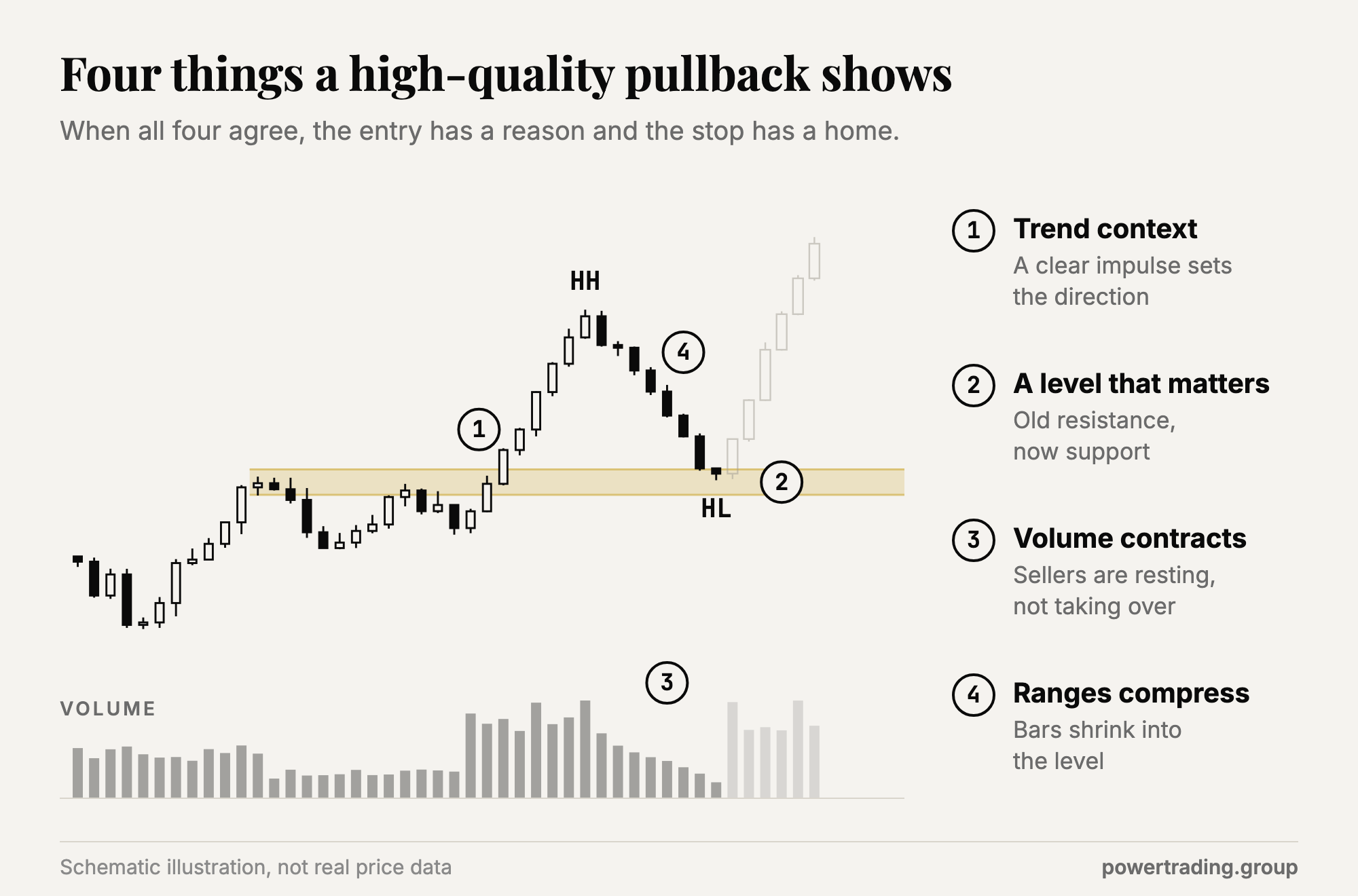
When all four elements line up, you have a confluence that meaningfully improves the probability of the trade working. Not a guarantee. Nothing in trading comes with a guarantee. But a setup where multiple factors are pointing in the same direction is the kind of trade you can take with conviction, manage with a tight stop, and execute consistently.
The Two Hour Trader framework is built around exactly this kind of setup. The pullback to VWAP in a trending session is one of the highest-probability entries you can take in NQ futures, and it's teachable because it has specific, observable criteria. You're not reading tea leaves. You're reading structure.
The No-Trade Day Version of This Lesson
There's a version of the pullback concept that applies not to individual trades but to entire sessions.
On August 13th, NQ broke out of its near-term range, and the only entry my system offered all morning was a pullback into the prior day high. The retracement was shallow and had no volume behind it, so I passed, set some price alerts, and called it a no-trade day.
Passing on it didn't bother me. The no-trade day is itself an application of the pullback principle: I wait for conditions to pull back to something that meets my criteria, and some sessions never offer that.
I said it directly that morning:
"Remember, a cash day is not a failure. No trade day is not a failure."
The traders who understand pullbacks as a philosophy, not just a setup, are the ones who can sit through a session like that without blowing up. They know what they're waiting for. They know what the market needs to show them before they engage. And they know that forcing action in the absence of that setup is just gambling with extra steps.
This connects directly to why consistent traders think about trading psychology differently. The emotional pressure to do something is real. Resisting it, especially on a day when nothing qualifies, is genuine skill.
Pullbacks and AutoPilot Trader
For traders who have internalized this framework but still struggle with execution in the moment, the first strategy inside AutoPilot Trader, the Two Hour Trader, automates this exact setup: the trend pullback to VWAP in NQ. It identifies the trend condition, waits for the retracement to the defined level, and executes when the criteria are met. APT runs it in Core and Shield builds, alongside a second strategy, Spring, that trades a different pattern.
What that automation solves is the psychological gap between knowing what to do and doing it when the moment arrives. The hesitation. The second-guessing. The impulse to chase when the setup runs without you.
Every APT figure lives on one page, the APT performance record, with drawdowns printed beside returns, losing months included, and every figure labeled as simulated. What the automation adds is consistency: the entry criteria get executed identically every time the setup appears.
Trading futures involves substantial risk of loss and is not suitable for every investor. Published AutoPilot Trader figures are simulated and do not guarantee future results. Testimonials reflect individual experiences.
A verified Trustpilot reviewer put it this way:
"I purchased APT and have been consistently winning with it. What I really appreciate is that Kyle personally trades the strategy himself, so he experiences both the good periods and the drawdowns right alongside everyone else."
The pullback setup doesn't care whether you're nervous about losing your account. It just executes.
Building the Habit
If you're still in the "chasing" phase, the practical path forward is deliberate repetition of a specific process.
Before the session opens, identify two or three levels where you would want to buy or sell a pullback. Be specific. Write them down. Then watch what price does relative to those levels. If price pulls back to one of your spots and shows the entry criteria, take the trade. If it doesn't, you don't trade.
Do this for a month. Track what happens at your pre-identified levels versus the entries you take impulsively outside of them. Most traders who do this exercise come back with a clear picture of where their edge actually lives.
The Thinktank's daily Premarket Prep is built around this kind of preparation. Before every session, members get a specific game plan with defined levels. That structure forces the preparation that makes pullback trading executable, because you can't wait patiently for something you haven't defined.
The traders who stick around long enough to develop consistency in this profession are almost always traders who got very good at one thing: waiting for the right pullback and taking it when it arrived. Everything else is noise.
Start with the levels. Build the habit. The rest follows from there.
If you want to see how this framework functions in a live trading environment, come spend some time in the Trader's Thinktank. Every session includes live NQ analysis, premarket levels, and real trade setups you can watch develop in real time. That's where the concept stops being abstract and starts being executable.