Day Trading: What It Actually Takes to Make Money in the Markets
Most people who try day trading fail within their first year. The data shows it, and I witnessed it firsthand when I started over a decade ago. The accounts go to zero, the confidence evaporates, and traders either quit or spend the next few years trying to figure out what went wrong.
But here's what the failure statistics don't tell you: the traders who stick around and put in the real work? They can build something genuinely life-changing. I've seen it happen dozens of times in our community. I've lived it myself.
This guide gives you an honest look at what this business actually requires: the skills, the mindset, the process, and the realistic timeline to get from where you are to where you want to be.
What Day Trading Actually Is (And What It Isn't)
Day trading is the practice of buying and selling financial instruments within a single trading session, holding no positions overnight. The goal is to profit from intraday price movement. Simple concept. Complicated execution.
The instruments day traders work with vary. Stocks, options, futures, forex, each has its own rules, capital requirements, and risk profile. At PTG, we focus almost exclusively on index futures, specifically NQ (Nasdaq-100 E-mini) and ES (S&P 500 E-mini). Futures give you leverage, favorable tax treatment, and markets that trade nearly 24 hours. For active day traders, they're often the better vehicle.
What day trading is NOT:
A passive income stream. At least not right away. You're actively managing risk in real time.
Gambling. Gambling has no edge. Trading, when done correctly, is a probability game with a statistical advantage.
Watching charts all day. The best traders I know have defined windows. We teach the Two Hour Trader methodology for a reason, more screen time doesn't equal more profit.
A shortcut to wealth. The timeline to consistent profitability is measured in years, not weeks.
The Market You're Competing In
One of the first things I tell newer traders in our Trader's Thinktank community is this: the market is a zero-sum game at the micro level. For every winning trade, someone else is on the losing side. Your competition isn't random, it includes algorithmic systems, prop firm traders, and institutional desks with decades of data and dedicated risk teams.
That sounds discouraging. It shouldn't be.
Institutions aren't trying to scalp 10 ticks out of a 5-minute candle on the NQ. Their size creates inefficiencies, and their herding behavior creates patterns. And those patterns, studied through price action, volume, and market structure, are exactly what retail traders can exploit.
But you have to understand what you're reading. The market leaves footprints, and learning to see them is the whole game.
Core Skills Every Day Trader Needs
Reading Price Action
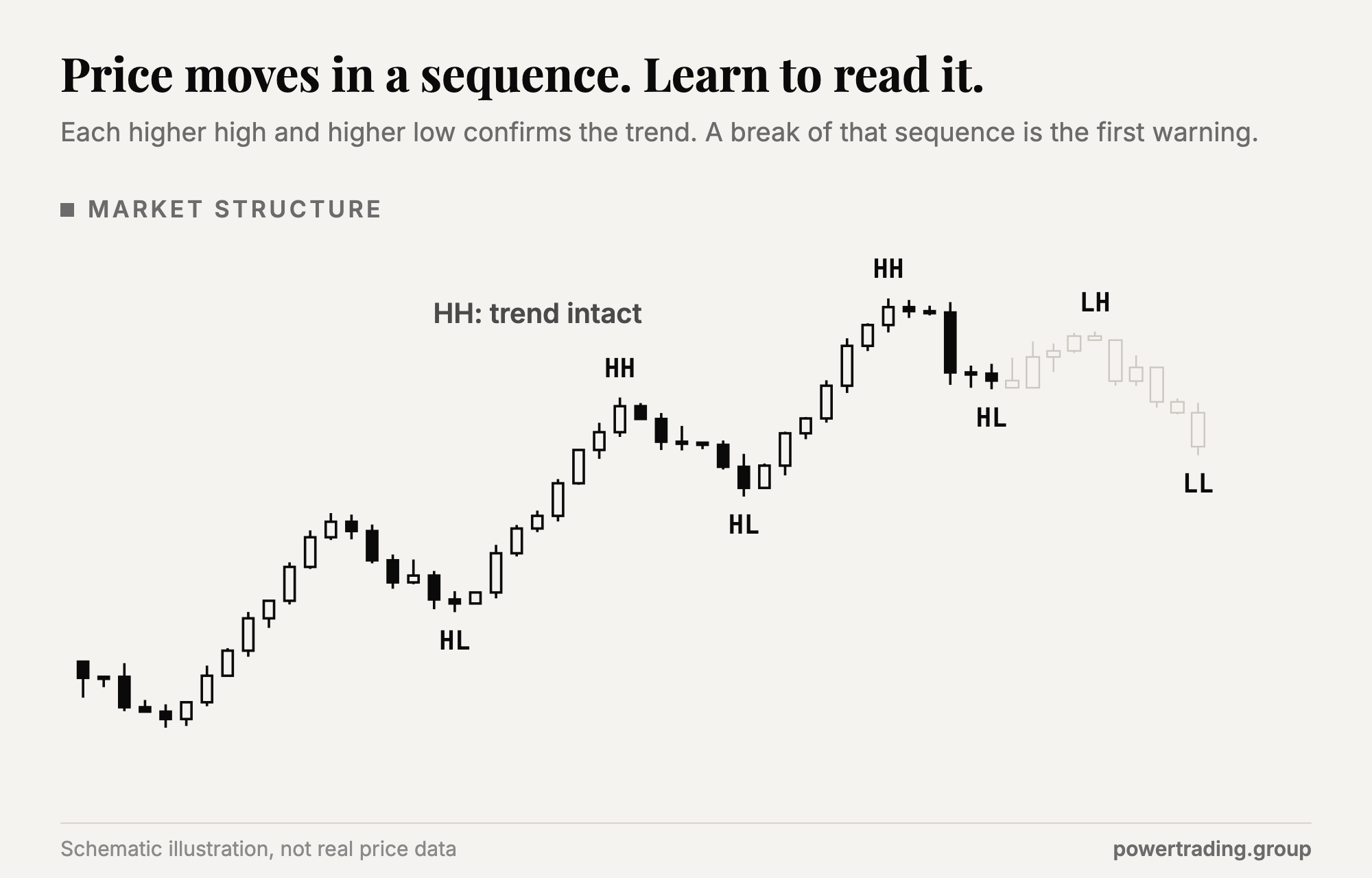
This is foundational. Before you worry about indicators, scanners, or strategies, you need to understand what price is doing and why. Price action is the raw language of the market, who's in control, where supply and demand are shifting, where momentum is building or exhausting.
I spent years studying Wyckoff methodology because it gets at the underlying logic of market movement: accumulation, markup, distribution, markdown. When you can read a chart through that lens, you stop reacting to noise and start responding to structure.
If you want to go deeper on reading the market's language, understanding market structure is the next logical step after price action basics.
Risk Management
No skill matters more than this one. None.
A trader with mediocre setups but excellent risk management will survive and grow. A trader with excellent setups and poor risk management will eventually blow up. I've watched it happen too many times.
The math is unforgiving. A 50% loss requires a 100% gain to break even. Most traders who blow accounts don't lose on one catastrophic trade, they take too many small-to-medium losses without capping them, and the drawdown compounds.
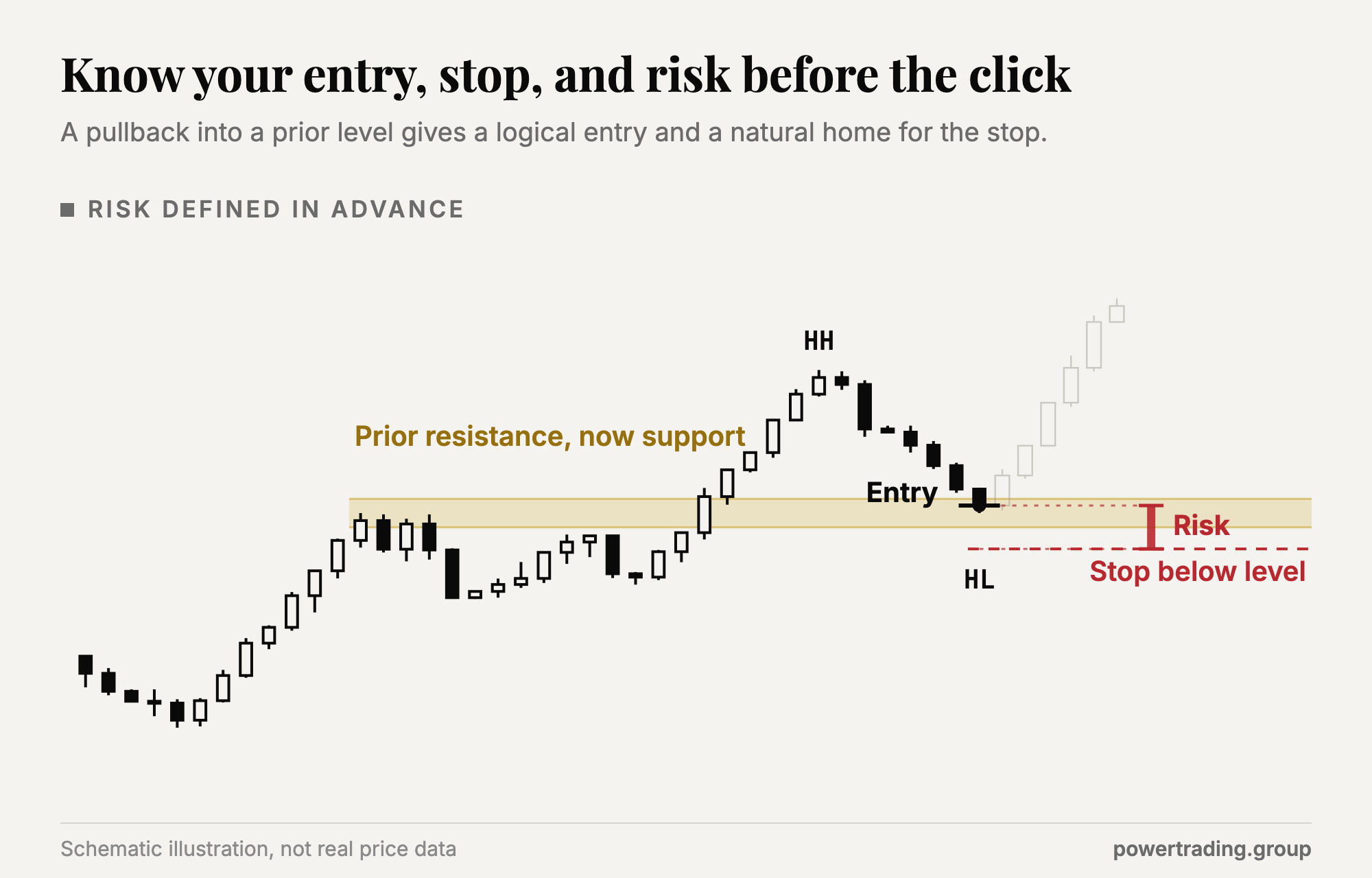
Before you place a trade, you should know three things: where your entry is, where your stop is, and what dollar amount you're risking. That's it. If you can't answer all three before you click, you're hoping, not trading.
Trading Psychology
This is where most traders lose the battle, and honestly it took me years to figure out how deep this rabbit hole goes.
Fear of missing out. Revenge trading after a loss. Holding winners too long because you want more, then watching the move reverse. These aren't character flaws, they're predictable human responses to financial stress. But they'll destroy your account if you don't develop awareness around them.
I wrote more about this in how to master trading psychology, but the short version is: your edge on paper means nothing if you can't execute it under pressure. The psychological side of this business is non-negotiable.
"Kyle has changed my view on trading and made me not only the best trader I can be but also the best version of myself." - Reece Davis
A Defined Strategy
You need one setup you know cold before you need ten setups you kind of understand. This is a lesson I learned the hard way, and one I see new traders repeating constantly.
The market will offer you dozens of opportunities every day. Most of them aren't yours. Your job is to wait for the specific conditions where your edge applies and execute with conviction. That requires having a defined strategy with clear entry criteria, stop placement logic, and target levels.
The easiest trading strategy for beginners is trend-following, and for good reason. It's the direction of least resistance. Master following the trend before you try to call reversals.
The Realistic Timeline
I want to be straight with you here because the industry is full of people who won't be.
Most traders take 2-4 years to reach consistent profitability. Some get there faster. Many take longer. The variables that matter most:
How much deliberate practice you put in (watching markets, reviewing trades, studying setups)
The quality of your education (learning from someone who actually trades, not theory)
Your risk management discipline (how well you protect capital during the learning curve)
Your psychological resilience (how you respond to drawdowns and losing streaks)
Capital preservation during the learning phase is everything. Your goal as a new trader is to stay in the game long enough to develop real competence. Holding that priority front of mind changes how you approach every session.
For a deeper look at this timeline, how long it takes to become consistently profitable breaks it down honestly.
"Prior to joining, I was a predictor and anticipator. I didn't have proper rules of engagement. Since joining, I have learned to be patient and actually learned to trade." - Robert Onsomu
Day Trading Futures vs. Stocks
This comes up constantly, so let's address it directly.
Stocks:
Thousands of symbols to track
Less leverage (4:1 intraday)
No 24-hour market access
Futures (NQ/ES):
Fewer instruments to master deeply
Higher leverage (varies by broker and account size), with near 24-hour markets (Sunday-Friday)
Favorable 60/40 tax treatment
Lower commissions at scale
For serious day traders, futures offer structural advantages. That's why most professional active traders end up there eventually. If you're getting started in futures, the NQ and ES are the two markets worth focusing on first.
Prop Firms: Trading Without Full Personal Capital
One path that's opened up significantly in the last few years is prop firm trading. Firms like Apex, TopStep, and others let you prove your skills with an evaluation challenge, then fund you to trade their capital.
Pass the evaluation, manage the account within their rules, and you keep a percentage of the profits without risking your own money at scale.
For traders who have the skills but not the capital, this is a legitimate path. The evaluations typically require:
Staying within daily loss limits
Not exceeding maximum drawdown
Hitting a profit target within a set number of days
Consistency matters more than big wins. A well-designed trading strategy, or even an automated system, that produces steady, controlled results is ideal for prop firm evaluations. In the Trader's Thinktank, we have members working through prop firm challenges every week, sharing what's working and what's not.
The Automation Question
At some point, many serious traders start asking about automation. And it's a legitimate question.
Emotional execution is one of the biggest performance drains in day trading. The strategy looks great on paper. In real-time, with real money, the same trader who planned perfectly hesitates on entries, moves stops, and exits winners early. The gap between theoretical performance and actual performance is almost always a psychological gap.
Automating a proven strategy eliminates that variable entirely. That's exactly why I built AutoPilot Trader, to take the Two Hour Trader framework I've used for years and execute it without the emotional interference. The results speak for themselves, and if you want to dig into the performance data, I lay it all out at /autopilot-trader.
Automation isn't a shortcut around learning to trade. But for traders who understand the market and have a proven methodology, it can be a powerful tool for removing the execution gap.
What Separates Traders Who Make It
After over a decade of trading and mentoring more than a hundred traders, I've noticed the same qualities in the ones who break through:
They review their trades. Not occasionally, consistently. They know their win rate, their average winner versus loser, their best and worst setups. The data tells you where your edge actually lives.
They protect capital obsessively. The traders who make it treat drawdowns as enemy territory. They cut losses fast and let winners develop.
They get in a room with better traders. There's no substitute for being around people who are doing what you want to do at a higher level. The accountability alone accelerates development. The analysis you're exposed to reshapes how you see the market.
They stop chasing strategies. The day they commit to mastering one approach instead of cycling through new systems every few weeks is often the turning point.
"I learned more from Kyle in one hour than I have from hours and hours of Youtube, reading articles, and taking courses from other groups." - Mike
Getting Started: The Honest Path Forward
If you're serious about day trading, here's the sequence that actually works:
Learn to read price action. Before anything else. Candlesticks, volume, key levels, trend identification.
Study market structure. Understand how markets move in phases, accumulation, trending, distribution.
Define one strategy with clear rules. Entry, stop, target. Write it down. Trade it on paper first.
Get into a community with accountability. Trading alone is hard. Trading with guidance and peer accountability is how you actually compress the learning curve. In our Trader's Thinktank community, members get live market coverage, daily analysis, and direct access to full-time traders every single session.
Review your trades obsessively. Your journal is your coach.
Scale slowly. Paper trading to sim to small live size. Earn your right to size up.
The path to consistent profitability is longer and harder than the market gurus want to admit. But for traders willing to put in the work, it's absolutely achievable.
The market will always be here. There's no deadline. Trade with patience, protect your capital, and keep learning, and this business can give you something genuinely rare: financial independence built on skill.