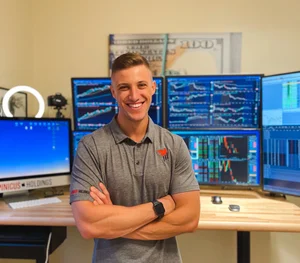
You're scrolling through YouTube, seeing traders posting screenshots of massive wins, claiming their Discord community is the secret. Five-figure days. Verified prop firm accounts. "Best community ever" plastered across the thumbnail.
So you join. You pay the monthly fee. And within a week, you realize something's off. The alerts come too late. The "verified trader" posts screenshots but never shares their actual P&L. The chat is just noise - 47 messages about some penny stock you've never heard of while NQ is breaking a key level.
I've been inside dozens of trading Discord servers over the past decade. Some as a member, some as a guest, and a few where I was asked to speak or collaborate. Here's what I've learned: most of them aren't worth the monthly subscription you're paying. Not because Discord is a bad platform - it's actually pretty solid for real-time communication - but because most trading Discords are fundamentally flawed in structure, incentives, and execution.
Let me walk you through what actually happens inside these communities, the red flags you need to spot, and what separates the few quality communities from the overwhelming majority of time-wasting noise factories.
Are Day Trading Discords Worth It? The Honest Truth
The short answer: it depends entirely on what you're looking for and how the community is structured.
Discord itself is just a tool. It's real-time chat with voice channels, file sharing, and role-based organization. It works fine for gaming, project collaboration, and even some types of trading discussion. The problem isn't the platform - it's how most trading Discord servers operate.
Here's what makes or breaks a trading Discord:
Signal-driven vs. education-driven: If the entire value prop is "we'll call out trades," you're already starting from a losing position. Signals might work for a handful of trades, but you're not learning to trade. You're learning to follow someone else. And when that person stops posting, changes their strategy, or - spoiler alert - starts losing, you have no foundation to stand on.
Accountability vs. hype: The best communities enforce structure. Trade journaling. Weekly reviews. Real coaching. Most Discord servers are just hype factories. Someone posts a big win. Everyone congratulates them. No one talks about the three losing weeks before that trade. No one analyzes risk management. Just vibes and wishful thinking.
Professional vs. social: Trading is a business. Discord servers that treat it like a hobby will attract hobbyists. If you want serious traders with real edge, you need a serious environment. That means moderation, quality control, and a leadership team that actually trades with real money every single day.
So the real question isn't "are Discord servers worth it?" It's "is this specific Discord server worth it?" And most of them aren't.
The Problem with Most Trading Discord Servers
I've seen the pattern repeat itself across dozens of these communities. Here's what goes wrong:
1. Noise Without Signal
You join expecting structured analysis and actionable insights. Instead, you get 400 messages a day about everything and nothing. Someone's ranting about Fed policy. Another person is sharing a meme. Three people are arguing about whether SPY is going to 600 or 400 by March.
Meanwhile, NQ just broke structure at a key level and you missed it because your notifications are full of garbage.
Real trading requires focus. Discord servers encourage the opposite. The structure rewards constant posting, not quality analysis. The most active users get the most attention, regardless of whether they're profitable.
2. Conflicting Information
You'll see five different people calling five different setups on the same instrument at the same time. One says long. Another says short. A third is waiting. Fourth guy just rage-quit after a loss and is posting about switching to crypto.
Who do you follow? How do you know who's actually profitable? Most servers don't verify results. They don't track performance. It's just a collection of opinions with no accountability.
3. Leader Doesn't Trade (Or Trades Poorly)
This is the big one. The person running the Discord - the one you're paying $50 or $99 or $199 per month - often isn't a profitable trader. They're a content creator who realized selling community access is more profitable than actually trading.
I've watched this play out repeatedly. The leader posts some trades. Shows some wins. But the losses are never discussed. The account size is vague. The actual P&L is hidden behind "I trade multiple accounts" or "I focus on education now, not trading."
Translation: they don't make money trading. They make money from your subscription.
4. No Structure, No Progression
Most Discord servers are just... rooms. You show up. You read chat. You leave. There's no curriculum. No skill progression. No coaching framework. Just chaos with the occasional stock alert mixed in.
Compare that to how actual professional traders develop: structured training, mentorship, journaling requirements, feedback loops, performance tracking. You won't find that in 99% of Discord communities.
Red Flags to Watch For in Trading Discords
If you see these patterns, run:
Verified screenshots with no verifiable track record: Anyone can Photoshop a screenshot. Even "verified" screenshots from platforms can be manipulated or cherry-picked. If the leader won't share their actual broker statement or prop firm account with complete trade history (wins AND losses), assume they're hiding something.
Constant upsells: Free Discord with paid "VIP" tier. Then another "elite" tier. Then "1-on-1 coaching" for $5,000. Then a course. Then indicator access. If the business model is stacking subscriptions, the focus isn't on your trading - it's on extracting maximum revenue from you.
Pump-and-dump language: "Loading here," "about to explode," "get in before liftoff" - this is manipulation language. Real traders don't talk like this. Scammers do.
No losing trades ever posted: Everyone loses trades. If the Discord leader only posts wins, they're either lying or showing you a curated highlight reel. Either way, you're not getting the full picture.
Founder is 19 years old: Not to be ageist, but if someone's been "trading professionally for years" and they're barely old enough to drink, something doesn't add up. Trading edge develops over years and market cycles. A teenager running a premium Discord is a red flag.
Discord is the entire business: If there's no other product, no trading bot with verified backtests, no transparent track record - just a Discord chat - then the product is your attention and subscription. There's no edge being shared because there is no edge.
What Makes a Quality Trading Community
I've been part of a few legitimately good trading communities. Here's what they have in common:
The leader trades every single day with real money. Not demo. Not sim. Real capital. And they share that process transparently - wins, losses, thought process, risk management. You watch them trade live, not just post screenshots after the fact.
There's a structured educational component. Courses, coaching calls, recorded sessions, frameworks, trade review systems. You're not just hanging out in a chatroom hoping to absorb skill through osmosis. There's a deliberate learning path.
Performance is tracked and verified. Whether it's prop firm payouts, broker statements, or third-party verified backtest results, there's proof of edge. Not marketing claims. Actual, verifiable data.
The environment is professional. Moderation. Quality control. No spam, no hype, no pump schemes. The focus is on skill development and execution, not vibes and moon talk.
There's real accountability. Trade journaling requirements. Weekly reviews. Feedback from experienced traders. You're not just lurking and hoping to get better. You're actively engaged in a structured improvement process.
Communities like this exist. They're rare. But they exist. The Trader's Thinktank is one of them - I'm biased, obviously, but we built it specifically to address everything I've seen go wrong in other communities. Daily livestream trading. Real premarket and session analysis. Group coaching with professional traders. No signals. No hype. Just edge.
Discord vs. Structured Trading Communities: The Key Differences
Let's be direct about this: Discord is a communication tool. A professional trading community uses communication tools (Discord, Circle, Slack, whatever) as part of a larger educational and coaching framework. But the tool isn't the product.
Here's the distinction:
Discord server: You pay for access to a chat room. Maybe there are channels for different topics. Maybe there's voice chat. But the value prop is "you get to be in the room where stuff happens."
Professional trading community: You pay for structured education, coaching, daily market analysis, trade review, and accountability. The chat platform is just the delivery mechanism. The value is in the content, the coaching, and the learning framework.
Most people looking for "trading Discord" really want what a structured community provides. They just think Discord is the entire solution. It's not. It's a piece of the infrastructure.
Think about it this way: if the Discord server disappeared tomorrow, would you lose access to education, coaching, trade breakdowns, performance tracking, and skill development? Or would you just lose access to a chat room where people talk about trades?
If it's the latter, you're overpaying.
How to Evaluate a Trading Discord Before Joining
If you're still considering joining a trading Discord (or any trading community), here's your due diligence checklist:
1. Verify the leader's track record: Ask for proof. Broker statements. Prop firm payouts. Verified backtest results if they're selling a strategy or bot. If they refuse or deflect, move on.
2. Check reviews outside their controlled channels: Don't just read testimonials on their website. Search Reddit, TrustPilot, Twitter. What are people saying when the founder isn't in the room?
3. Ask about the refund policy: Legitimate communities stand behind their value. If there's no refund policy or trial period, that's a red flag. They know if you actually experience the community, you'll want your money back.
4. Request access to a sample coaching call or recorded session: If education is part of the pitch, you should be able to preview the quality before paying. If they won't show you a sample, assume the quality is low.
5. Gauge the tone and professionalism: Lurk in any public channels or preview content. Is it professional? Structured? Or is it just memes and hype?
6. Check the leader's content history: How long have they been posting? Do they show losses? Do they explain their thought process or just post screenshot wins? Consistency and transparency over time matter more than a few highlight-reel trades.
The Alternative: Professional Trading Communities
Here's what I built the Trader's Thinktank to be: the opposite of everything that's broken in most trading communities.
Every morning at 8:45 AM, I publish Premarket Prep notes. Specific NQ levels. Economic data. Game plan for the session. Then I livestream my full trading screen from market open to close. You watch me take trades in real time. You see the wins. You see the losses. You see the decision-making process as it happens.
We do weekly group coaching calls with professional traders. You submit your trades. We review them. We give feedback. We help you identify patterns in your execution. No fluff. No generic advice. Specific, actionable coaching.
The Two Hour Trader framework is included free with membership. It's the exact setup I trade every day and the first strategy AutoPilot Trader automated. You learn the strategy. You practice it with guidance. You execute it with accountability.
We're not a Discord server pretending to be a trading community. We're a trading community that happens to use communication tools (including Discord-style channels) as part of the infrastructure.
If you've been burned by other communities, I get it. If you're skeptical of anything that looks like a premium chatroom, I don't blame you. But if you want what professional trading communities actually provide - education, coaching, structure, accountability, and real transparency - check out what we're doing. No signals. No hype. Just edge.