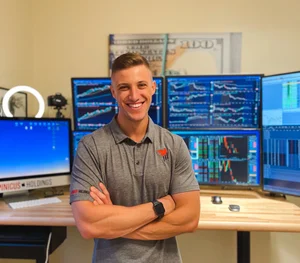
From $26K to -$15K to $38K: What 3 Months of AutoPilot Trader Actually Looks Like
Most trading bot case studies show you the highlight reel. Five-figure months. Perfect equity curves. Zero drawdowns.
This isn't that.
Andrew started running AutoPilot Trader in December 2025. His first month? $26,100 in profit. Exceptional start. Then January hit. He gave back $15,400. Real money. Real drawdown. Real trader experiencing what every systematic strategy eventually faces: adversity.
Here's what happened next - and why it matters more than the winning month.
The Numbers (TradeZella-Verified)
3-Month Performance (Dec 2025 - Feb 2026):
Net P&L: +$38,135
Total Trades: 134 (79 wins, 55 losses)
Win Rate: 58.96%
Profit Factor: 1.20
Day Win Rate: 57.45% (27 winning days, 20 losing days)
Position Sizing:
6 NQ contracts
12 YM contracts
This is real funded account trading. Not sim. Not "what if." Real capital, real execution, real results.
Month 1: The Strong Start (December 2025)
Andrew started running APT mid-December. Within 11 trading days, he was up $26,100.
Notable Days:
Dec 12: +$8,300
Dec 18: +$10,900
Dec 24: +$3,550
Dec 29: +$6,440
Three losing days mixed in:
Dec 15: -$9,000
Dec 23: -$70
Dec 26: -$1,330
Everything worked. The system caught clean moves. Drawdowns were minor. If you only saw December, you'd think this was effortless.
Month 2: The Reality Check (January 2026)
January was brutal.
20 trading days. Net P&L: -$15,400.
This wasn't a minor pullback. This was a full month of giving back gains. The kind of month that makes traders question the system, tweak settings, or shut it off entirely.
The Damage:
Jan 21: -$19,400
Jan 22: -$11,000
Jan 23: -$9,920
Three consecutive days that erased most of December's profit.
Good days were still mixed in - Jan 8 (+$9,760), Jan 14 (+$11,500), Jan 7 (+$7,960) - but they couldn't overcome the losses.
What Most Traders Do Here
They panic. They stop the bot. They convince themselves "the market changed" or "the system stopped working."
Andrew didn't.
Month 3: The Comeback (February 2026)
February delivered Andrew's best month: +$38,100 across 15 trading days.
Big Days:
Feb 4: +$16,900
Feb 5: +$28,300
Feb 24: +$12,700
Feb 26: +$10,300
Losing days were still there:
Feb 9: -$9,340
Feb 12: -$11,500
Feb 13: -$19,200
But here's what's interesting: Andrew's trade frequency dropped in the second half of February. Early in the month, he was taking 4+ trades per day. By the back half, it was down to 2 trades per day.
This suggests discipline. When conditions weren't optimal, he let the bot sit idle rather than forcing execution. The system is programmed to filter for high-probability setups, but the trader still controls whether it's active.
The Real Lesson: Systems Work Over Time, Not Every Day
Andrew's 3-month net: +$48,800 (December: +$26,100, January: -$15,400, February: +$38,100).
This is what systematic trading actually looks like:
Strong periods where everything clicks
Drawdown periods where you take heat
Recovery periods where discipline pays off
If you only saw December, you'd think it's easy money. If you only saw January, you'd think it's broken. February shows what happens when you stay the course.
What Makes This Different from Manual Trading
Most retail traders can't survive January.
Not because of the drawdown itself - professional traders expect drawdowns. But because of the psychological toll of watching losing trades execute while you second-guess every decision.
With AutoPilot Trader, Andrew didn't have to make those decisions. The system executed its logic regardless of how the previous day went. No revenge trading. No "sit this one out" after a bad day. No emotional override.
The algorithm doesn't care about yesterday's P&L. It only cares about current market structure and whether conditions meet entry criteria.
The Strategy Behind the Numbers
Andrew is running AutoPilot Trader - the same Two Hour Trader framework I've used for over a decade, fully automated.
This isn't a black box. It's a systematic implementation of price action principles:
Break of structure confirmation
Pullback entries with precise invalidation
Dual profit target management (PT1 → breakeven, PT2 → trail)
Proprietary volatility and trend filtering
The same logic that generated $306,405 in backtested profit across 1,045 trades. The same logic that shows 100% profit probability across 1,000 Monte Carlo simulations for NQ Long-Only mode.
Andrew's results validate what the backtest showed: the edge is real, but it doesn't win every day.
Why January Matters More Than December
Anyone can show you a winning month. That's marketing.
Showing you the losing month - and what happens after - that's transparency.
January proves the system doesn't hide from reality. Drawdowns happen. They're documented. They're expected. And when you stay disciplined through them, February happens.
This is the difference between a real trading system and vaporware.
What Andrew Did Right
1. He sized appropriately. 6 NQ + 12 YM is meaningful capital, but not reckless. He could withstand January's drawdown without blowing up.
2. He didn't override the system. When January hurt, he didn't shut it off or start manually trading. He let the edge play out.
3. He adjusted activity intelligently. The reduced trade frequency in late February suggests he understood when to step back without abandoning the system entirely.
4. He trusted the process through adversity. Most traders quit during January. Andrew stayed.
The Bigger Picture
AutoPilot Trader isn't "set it and forget it" in the sense that you can ignore it completely. You still need to:
Monitor execution and broker connectivity
Understand when market conditions shift dramatically (major news events, extreme volatility)
Manage position sizing relative to account growth
Have realistic expectations about drawdowns
What it does eliminate is emotional decision-making during execution. The hardest part of trading - pulling the trigger when you're scared, cutting losses when you want to hold, taking profits when you want more - is removed.
The system follows its rules. Every time. No exceptions.
How to Access AutoPilot Trader
APT is currently priced at $5,000/year (annual license).
We're capping enrollment at 250 active traders to protect system performance. As we approach that cap, the price increases to $7,997/year.
What's included:
Full algorithm access (NQ Long-Only, NQ 2-Way, YM Long-Only, YM 2-Way, plus Micro variants)
White glove setup on live Zoom call (avg 35 minutes)
All future strategy updates and optimizations
Priority support
Private trader community
You'll also need:
Third-party execution platform ($40/month)
TradingView Premium ($49/month)
Minimum account size: $10,000 for Micro contracts, $25,000+ for standard contracts.
Learn more about AutoPilot Trader here
If you want to see the full V3 backtest results - including the complete Monte Carlo analysis, drawdown charts, and monthly breakdown - check out the V3 Dashboard.
Final Thoughts
Andrew's story isn't sexy. It's not "turned $500 into $50K in 30 days." It's not a flawless equity curve.
It's real.
$26K up. $15K down. $38K up. Net result: nearly $49K over 3 months with a systematic strategy that doesn't require screen time.
If you're looking for guarantees or perfection, this isn't it. No system delivers that.
But if you're looking for a proven edge that executes without emotional interference - and you can handle the reality that drawdowns are part of the process - this is exactly what systematic trading looks like.
Andrew stayed disciplined through January. February rewarded that discipline.
That's the real case study.