The Complete Guide to Futures Trading for Beginners
Most futures trading guides read like textbooks written by people who've never actually traded. They throw around terms like "standardized contracts" and "mark-to-market settlement" without explaining what any of it means when you're actually sitting in front of your trading platform at 9:30 AM Eastern.
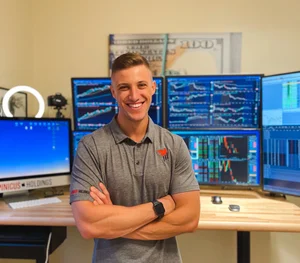
I've been trading futures full-time for over a decade. ES and NQ are my bread and butter. And I can tell you this: futures trading isn't nearly as complicated as the regulatory websites and broker marketing materials make it sound.
Here's what futures trading actually is, how it works in practice, and whether it's the right instrument for your trading style. No jargon unless I explain it. No theory you can't use. Just what you need to know.
What Are Futures Contracts? (Plain-English Breakdown)
I've been trading futures full-time for over a decade. ES and NQ are my bread and butter. And I can tell you this: futures trading isn't nearly as complicated as the regulatory websites and broker marketing materials make it sound.
Here's what futures trading actually is, how it works in practice, and whether it's the right instrument for your trading style. No jargon unless I explain it. No theory you can't use. Just what you need to know.
What Are Futures Contracts? (Plain-English Breakdown)
A futures contract is an agreement to buy or sell something at a specific price on a specific future date. That "something" can be a commodity like crude oil or gold, a stock index like the S&P 500 (ES) or Nasdaq-100 (NQ), a currency, bonds, or even Bitcoin.
You're not buying the actual asset. You're trading the contract itself.
When I trade NQ futures, I'm not buying shares of the Nasdaq-100 index. I'm entering a contract that tracks the value of that index. Each point of movement is worth $20 on the standard contract (or $2 on the micro contract). If NQ moves from 18,000 to 18,010, that's $200 per contract.
The key thing that makes futures different from stocks: leverage. You don't need the full contract value to trade. You post margin (think of it as a good-faith deposit). This is both the power and the risk of futures.
Let's say NQ is trading at 18,000. The full contract value is $360,000 (18,000 x $20). But you might only need $17,000 in margin to control that position. That's roughly 20:1 leverage.
This magnifies both gains and losses. A 50-point move ($1,000) on a $17,000 margin requirement is a 5.9% return. In stocks, you'd need $360,000 in capital for the equivalent position. That's the appeal of futures.
It's also why risk management matters more than in any other instrument.
The Four Types of Futures You'll Actually Trade
Index futures (ES, NQ, YM): Track major stock indexes. High liquidity, tight spreads, perfect for day traders. This is where most active retail traders operate.
Commodity futures (crude oil, gold, corn, natural gas): The original futures markets. More influenced by supply/demand fundamentals and geopolitical events. Typically wider spreads than index futures.
Currency futures (EUR, GBP, JPY): Less popular among retail traders since spot forex offers better execution for currencies. But they exist.
Interest rate futures (Treasury bonds, Eurodollars): Institutional domain. Unless you're trading a macro strategy or hedging bond exposure, you probably won't touch these starting out.
Most beginner futures traders start with ES or NQ. High liquidity, excellent price action, and you're trading something you already understand (the stock market).
How Futures Trading Actually Works (Mechanics)
Futures trade nearly 24 hours a day, five days a week. ES and NQ open Sunday evening at 6:00 PM Eastern and close Friday at 5:00 PM Eastern. There's a brief maintenance window each day from 5:00-6:00 PM.
This is massive for traders with day jobs. You can trade the overnight session, the European open, or the US cash session. You're not limited to 9:30 AM to 4:00 PM like with stocks.
Margin and Leverage
There are two types of margin in futures:
Initial margin is what you need to enter a position. For NQ, it's typically around $17,000 per contract (this changes based on volatility).
Maintenance margin is the minimum you need to keep the position open. Usually about 80% of initial margin.
If your account drops below maintenance margin, you get a margin call. Your broker will either demand more funds or liquidate your position. This is not theoretical. It happens.
Contract Specifications
Every futures contract has standardized specifications:
- Tick size: Minimum price movement (0.25 points for NQ = $5)
- Point value: Dollar value per full point ($20 for NQ, $50 for ES)
- Contract months: Futures expire. Most active contracts are quarterly (March, June, September, December)
- Trading hours: Nearly 24/5 for major contracts
- Last trading day: When the contract expires and you must exit or roll
Most retail traders never hold contracts to expiration. We're in and out intraday, or we roll to the next contract month before expiration.
Rolling Contracts
"Rolling" means closing your position in the expiring contract and opening it in the next contract month. Institutional traders and long-term position traders do this regularly. Day traders generally don't worry about it since we're flat by end of day.
There's typically a "roll window" about a week before expiration when volume shifts from the front month to the next. Just be aware of it.
Futures vs Options vs Stocks (Which Fits Your Style?)
Every trader asks this. Here's the real-world breakdown:
Futures pros:
- Leverage (control large positions with smaller capital)
- Tax efficiency (60/40 treatment in the US: 60% long-term gains, 40% short-term, regardless of holding period)
- Nearly 24-hour trading
- No pattern day trader rule
- Excellent liquidity in major contracts
- Symmetrical risk (long and short are equal)
Futures cons:
- Leverage cuts both ways (you can lose more than your initial margin if you're not managing risk)
- Requires more capital than stocks ($10K+ realistically, $25K+ comfortably)
- Faster pace (especially during cash hours)
- Margin calls are real
Options pros:
- Defined risk (you can't lose more than premium paid when buying)
- Versatile strategies (spreads, butterflies, iron condors)
- Smaller capital requirement for some strategies
Options cons:
- Time decay eats premium
- More complex mechanics (Greeks, implied volatility)
- Lower liquidity than futures in many underlyings
- Wider bid-ask spreads
Stocks pros:
- Simpler to understand
- Own actual equity
- No expiration
- Dividends
Stocks cons:
- Pattern day trader rule (need $25K to day trade)
- Less leverage than futures
- Can't trade overnight (except limited extended hours)
- Long/short asymmetry (harder to short)
The truth is, it depends on your trading style and capital.
If you're a day trader focused on index movements, futures are hard to beat. If you have $10K to $25K and want to actively trade the market, micros (MES, MNQ) are perfect.
If you're a swing trader with smaller capital, stocks or options might fit better.
If you're building longer-term positions and managing risk with spreads, options make sense.
I trade futures because I'm focused on intraday price action on NQ and ES. The leverage, liquidity, and tax treatment align perfectly with my strategy. Your situation might be different. If you're looking to automate a proven strategy, check out AutoPilot Trader — it runs the same framework I trade manually.
Getting Started with Futures Trading (Step-by-Step)
Here's the process without the fluff:
1. Get Funded ($10K minimum, $25K comfortable)
You can technically open a futures account with less, but you'll be undercapitalized. One bad trade or unexpected margin increase and you're done.
Micro contracts (MES, MNQ) dropped the barrier significantly. You can realistically trade MNQ with $10K. But $25K gives you breathing room for full-size contracts and proper risk management.
2. Choose a Futures Broker
Not all brokers offer futures. You'll need a specialized futures broker or a stock broker that also offers futures.
What to look for:
- Low commissions (futures commissions are per-contract, not percentage-based)
- Good platform (fast execution, reliable data feed)
- Reasonable margin requirements
- Quality customer support
- Solid track record
Popular choices: TradeStation, NinjaTrader, Interactive Brokers, TastyTrade, Tradovate. Each has pros and cons. Research what fits your needs.
3. Learn the Platform
Before you risk real money, learn how to:
- Enter and exit orders (market, limit, stop)
- Set stop losses
- Flatten positions quickly (critical for risk management)
- Read the DOM (depth of market)
- Check margin requirements in real-time
Sounds basic, but I've seen traders blow accounts because they didn't know how to exit a position properly during volatile conditions.
4. Master Risk Management First
This is where most beginners fail. They learn the mechanics and start trading without a risk framework.
Here's mine:
- Never risk more than 1-2% of account per trade
- Always use hard stops (not mental stops)
- Know your max daily loss limit before you start trading
- Position size based on stop distance, not how many contracts "feel right"
If you have a $25K account and risk 1% per trade, that's $250 max loss per trade. If your strategy uses a 20-point stop on NQ ($400 per contract), you're limited to half a contract.
This math matters more than any indicator or pattern.
5. Trade One Setup Until It's Profitable
Don't try to master every futures strategy at once. Pick one high-probability setup. Trade it. Track it. Refine it. Only add new setups once the first one is consistently profitable.
In the Trader's Thinktank, we teach a structured two-hour trading approach focused on specific NQ and ES setups. One setup. One time window. Mastery over complexity.
6. Use Automation If Execution Is Your Weakness
Look, not everyone can sit in front of charts executing perfectly for hours. Emotions, fatigue, and FOMO sabotage even good strategies.
That's why I built AutoPilot Trader. It's my exact Two Hour Trader framework, fully automated. NQ Long-Only strategy posted a 73.5% win rate and 4.05 Sharpe ratio in backtesting. The system removes the execution variable entirely.
You still need to understand the strategy. But you don't need to be glued to your screen.
Essential Futures Trading Strategies for Beginners
Most beginners think they need a library of strategies. You don't. You need one or two that fit your personality and schedule.
Trend Following
Wait for a clear directional move, then enter pullbacks in the direction of the trend. Works well in trending markets (obviously), struggles in choppy range-bound conditions.
Key tool: Moving averages, higher highs/higher lows for uptrends, lower highs/lower lows for downtrends.
Risk: Getting chopped up when the market shifts from trending to ranging.
Breakout Trading
Enter when price breaks through a significant level (previous day's high/low, overnight range, key pivot). The idea is to catch momentum when it starts.
Key tool: Support/resistance levels, volume confirmation.
Risk: False breakouts. Price breaks the level, you enter, then it reverses immediately.
Range Trading (Mean Reversion)
Sell the top of the range, buy the bottom. Works beautifully in choppy markets, gets destroyed in strong trends.
Key tool: Identifying ranges, using oscillators to confirm overbought/oversold.
Risk: The range breaks and you're caught on the wrong side of a strong move.
Opening Range Breakout
A classic day trading strategy. Identify the range in the first 15-30 minutes, then trade the breakout of that range.
Key tool: Mark the high/low of the opening period, wait for price to break out with volume.
Risk: Lots of false breakouts in the opening minutes.
My Personal Approach: Price Action + Volume
I trade pullbacks in established trends. Wait for a strong directional move, let price pull back to a key level, confirm with volume, then enter in the direction of the trend.
This is what the Two Hour Trader framework is built around. High-probability setups during the most liquid hours. Not all-day grinding.
The key is this: pick one strategy and trade it until it's second nature. Master the execution, the risk management, and the emotional control required. Then consider adding more.
Risk Management in Futures (What Most Guides Skip)
Everyone talks about strategy. Almost no one talks about what actually keeps you in the game: risk management.
Hard Stops, Always
Mental stops don't work. The moment you're in a losing trade, your brain will rationalize why it's about to turn around. Use hard stops. Every trade. No exceptions.
Position Sizing Based on Stop Distance
If your stop is 10 points away and your risk tolerance is $250, you can trade more contracts than if your stop is 30 points away. This is basic math, but most traders ignore it and just trade "one contract" every time.
Formula: (Account Risk Per Trade) / (Stop Distance in Dollars) = Max Position Size
Example: $500 risk, 20-point stop on NQ ($400 per contract) = 1.25 contracts max. Round down to 1.
Daily Loss Limits
Set a maximum daily loss and walk away when you hit it. Revenge trading after a bad morning is the fastest way to turn a manageable loss into an account-ending disaster.
Mine is 2% of account value. If I hit that, I'm done for the day. No exceptions. No "just one more trade to make it back."
Avoid Overleveraging
Futures give you leverage. That doesn't mean you should use all of it. Trading 10 NQ contracts on a $50K account because your margin requirement allows it is insane.
Rule of thumb: If a 10-point adverse move would stress you out, you're overleveraged.
Tools and Platforms for Futures Trading
You need three things: a broker, a charting platform, and a data feed. Sometimes these are bundled, sometimes separate.
Brokers (Mentioned Earlier)
TradeStation, NinjaTrader, Interactive Brokers, TastyTrade, Tradovate. All solid choices depending on your needs.
Charting Platforms
TradingView: Best web-based charting. Great for price action traders. Integrates with some brokers.
NinjaTrader: Powerful desktop platform. Built for futures. Steep learning curve.
Sierra Chart: Institutional-grade, highly customizable. Not beginner-friendly.
ThinkOrSwim: Good for multi-asset traders (stocks, options, futures). Slower execution than futures-specific platforms.
I use TradingView for charting and analysis. Simple, clean, fast.
Market Data
Most brokers provide real-time data, but you're paying exchange fees. For CME futures (ES, NQ, YM), expect $5-10/month in data fees.
Automation
If you want to automate execution (which I highly recommend if you have a proven strategy), you'll need a platform that supports it.
AutoPilot Trader runs through TradingView alerts connected to a third-party execution platform. Setup takes about 35 minutes on a Zoom call. After that, it runs without you.
Common Mistakes New Futures Traders Make
I've mentored over 100 traders since 2017. These are the patterns I see over and over:
1. Trading Too Many Contracts Too Soon
You open a $25K account, see you can trade 5 NQ contracts based on margin, and you do it. One bad trade and you're down 10%. Two bad trades and you're mentally shaken.
Start small. One contract (or one micro). Prove you can be profitable before scaling.
2. No Trading Plan
"I'll just see what the market gives me today." That's not a plan. That's gambling.
A real plan includes:
- What setups you're looking for
- Entry rules
- Stop loss placement
- Profit target(s)
- Max trades per day
- Max loss per day
3. Ignoring Time of Day
Not all trading hours are equal. The most liquid, volatile hours for ES and NQ are 9:30 AM to 11:30 AM Eastern (cash open). Overnight sessions are thinner, choppier.
If your strategy requires volume and liquidity, trade the right hours. Don't fight the overnight grind if you're a price action trader.
4. Chasing Losses
You lose $500 in the morning. Instead of stepping back, you trade aggressively to "make it back." You're now emotional, not strategic. This rarely ends well.
Accept the loss. Review what went wrong. Stick to your daily loss limit.
5. No Performance Tracking
If you're not tracking your trades (entry, exit, P&L, setup type, emotional state), you're flying blind. You have no idea what's working and what's not.
Use a journal. Spreadsheet. TradeZella. Edgewonk. Something. Track everything.
6. Overcomplicating the Setup
Fifteen indicators on the chart. Six different timeframes. Waiting for "confirmation" from all of them before entering.
By the time you get all your signals, the move is over.
Simple beats complex. Price action, key levels, volume. That's 90% of what you need.
Frequently Asked Questions
How much money do I need to start trading futures?
Technically, you can open an account with a few thousand dollars and trade micros (MES, MNQ). Realistically, $10K is the minimum for micros, $25K is comfortable for standard contracts.
Is futures trading riskier than stocks?
Futures use leverage, so yes, the risk is amplified. But "risk" depends on how you manage position size and stops. A trader with disciplined risk management in futures can be safer than a reckless stock trader.
Do I need to worry about futures expiration as a day trader?
Not really. If you're flat by end of day, expiration isn't relevant. Just be aware of the "roll" period about a week before expiration when volume shifts to the next contract month.
Can I trade futures in my IRA?
Some brokers allow futures trading in IRAs, but there are restrictions (no margin, limited strategies). Check with your specific broker.
What's the difference between E-mini and Micro futures?
E-mini contracts (ES, NQ, YM) are the standard size. Micro contracts (MES, MNQ, MYM) are 1/10th the size. If NQ moves 1 point, that's $20 on the E-mini and $2 on the Micro.
Should I trade NQ or ES?
Depends on your style. NQ is more volatile, bigger moves, higher risk/reward. ES is smoother, slightly lower margin. Most tech-focused traders prefer NQ. Most institutional-focused traders prefer ES.
Can I make a living trading futures?
Yes. I do. But it's not easy and it's not fast. You need capital, a proven strategy, disciplined risk management, and the emotional control to execute consistently.
What's the tax treatment for futures?
In the US, futures have a 60/40 tax treatment: 60% of gains are taxed as long-term capital gains, 40% as short-term, regardless of holding period. This is more favorable than short-term stock gains. Consult a tax professional for your specific situation.
Final Thoughts: Futures Aren't Exotic, They're Just Different
The trading education industry loves to make futures sound mysterious or dangerous. They're not. They're a leveraged instrument with specific mechanics. Once you understand how they work and respect the risk, they're one of the cleanest instruments to trade.
You don't need to be a genius. You don't need to watch charts 12 hours a day. You need a solid strategy, proper risk management, and the discipline to execute your plan.
If you're serious about learning futures trading in a structured environment with real traders, join us in the Trader's Thinktank. We trade ES and NQ live every day. You'll see exactly how we analyze the market, identify setups, and manage risk.
And if you want to skip the execution part entirely, AutoPilot Trader runs my Two Hour Trader strategy automatically. NQ Long-Only has a 73.5% win rate in backtesting. You focus on funding and risk management. The system handles execution.
Futures trading isn't for everyone. But if you're tired of the pattern day trader rule, want leverage without complexity, and you're ready to trade like a professional, it's worth learning.
Ready to start? Let's go.