Why Most Trading Algorithms Fail (And the 3 That Don’t)
There's a version of trading that sounds almost too good.
You build a system, or you buy one. You let it run. The computer executes every trade while you're at the gym, at dinner, asleep. No emotions. No hesitation. Just algorithmic precision printing money while you live your life.
Millions of traders have chased that version. Most of them are broke.
Here's the uncomfortable truth: roughly 90% of trading algorithms lose money over any meaningful time horizon. Not because automation is a bad idea. Not because algorithmic trading doesn't work. But because most algorithms are built on sand, validated with bad methodology, and released into live markets without any real understanding of why they fail.
I've been trading the markets for over a decade. I've seen traders blow up accounts chasing signals, indicators, and black-box systems that worked brilliantly in backtesting and crumbled the moment real money touched them. And I've spent years building something that actually works. The difference between what fails and what doesn't is specific, repeatable, and worth understanding before you trust any system with your capital.
Let's break it down.
Why the Promise of Trading Bots Keeps Drawing People In
The appeal is rational. Markets are theoretically inefficient. Human emotions create predictable patterns. Computers don't have fear, greed, or FOMO. If you could capture a systematic edge and execute it consistently without interference, you should outperform discretionary trading.
That logic isn't wrong. It's the execution that breaks down.
The gap between 'algorithms can work' and 'your algorithm will work' is filled with five specific failure modes that kill the vast majority of trading systems before they even have a chance.
5 Reasons Most Trading Algorithms Fail
1. Overfitting to Historical Data
This is where most algorithms die before they're even born.
You take a dataset of historical prices. You run tests. You adjust parameters until the equity curve looks beautiful. Maybe 85% win rate over the last three years. The Sharpe ratio is through the roof. You've cracked it.
Then you go live. And the system starts losing immediately.
What happened? You weren't finding an edge. You were memorizing the past. Overfitting (also called curve-fitting) means your parameters are tuned specifically to the noise in your historical sample, not the underlying market dynamics that generate the patterns. The moment the market produces a slightly different type of noise, your system falls apart.
The telltale signs: backtested performance that looks almost too perfect, a massive drop-off on out-of-sample data, and parameters that have no logical basis beyond 'this is what worked in this specific dataset.'
A properly validated system performs reasonably well on data it's never seen. If your out-of-sample results look dramatically different from your backtest, you have a memorization problem, not an edge.
2. No Genuine Statistical Edge
Removing the human element doesn't give you an edge. It just executes whatever strategy you built, with perfect consistency. If the strategy has no edge, you're automating your losses.
Most retail trading algorithms are built around indicators: moving average crossovers, RSI signals, Bollinger Band breaks. Here's what those systems actually are. They're pattern recognition tools that describe what price has already done. The question is whether those patterns have predictive value going forward. In most cases, once you add transaction costs and slippage, they don't.
A real edge means your strategy produces a positive expected value per trade. Not just in the past. Not just in one market regime. Not just with optimized parameters. It has to hold up across different instruments, different time periods, and different market conditions. That's a high bar, and most algos don't meet it.
3. Poor Execution Assumptions
Backtesting operates in a fantasy world. You assume you get filled at the exact price you wanted, instantly, every single time.
Live markets don't work that way.
Slippage on NQ futures can run 1-2 points per trade. Latency in your order routing adds more. In a fast-moving market, you might be trying to execute at one price while the market is already 5 points away. An algorithm that looks marginally profitable in backtesting can easily become a net loser once you account for the real-world friction of actually getting filled.
This is why execution infrastructure matters. The difference between a system that hits its theoretical targets and one that consistently underperforms them is often entirely about the execution layer, not the strategy itself.
4. Inadequate Risk Management
Most amateur-built algorithms have position sizing that looks like an afterthought. Fixed lot sizes. No account for volatility regime. No daily loss limits. No drawdown protocols.
The result is what traders call getting blown up. An algorithm without proper risk controls will find a way to lose everything given enough time and a bad enough streak. Markets produce outlier events. Your risk management has to be built for them, not just for the average case.
Position sizing should scale with volatility. Daily loss limits should cap the worst case. Drawdown thresholds should force the system into reduced risk or a pause. These aren't optional features. They're the difference between a system that survives bad periods and one that doesn't.
5. Failure to Adapt to Changing Market Regimes
A trending market strategy gets destroyed in a ranging market. A mean-reversion strategy falls apart in a strong trend. Market character shifts over time, and an algorithm that worked brilliantly in 2021 can turn into a consistent loser by 2023 without a single change to its code.
This is the most insidious failure mode because it doesn't show up in backtesting. Your strategy worked for the period you tested it. That period is over.
Robust algorithms either adapt dynamically to regime changes or they're built around an edge that persists across multiple regimes. Both approaches are possible. Most retail algorithms have neither.
The 3 Types of Algorithms That Actually Work
Not all algorithmic strategies are built on sand. There are three approaches with genuine track records. They share one common characteristic: a real statistical edge that's been validated with rigorous methodology, not just a well-tuned backtest.
1. Market Making
Market makers profit from the bid-ask spread. They buy at the bid, sell at the ask, and capture the difference thousands of times per day. The edge is structural: they're providing liquidity and getting compensated for it.
The catch for retail traders: this requires co-location, sophisticated technology infrastructure, and significant capital. The edge has also been largely arbitraged away at the retail level by institutional market makers with better technology and tighter spreads. This isn't a realistic option for most traders reading this.
2. Statistical Arbitrage
Statistical arbitrage exploits temporary price discrepancies between correlated instruments. When two historically correlated assets diverge, the strategy bets on convergence. When they converge, you unwind the position.
It works because it has a structural basis: related assets shouldn't diverge permanently. The challenge is that the most obvious opportunities have been captured by hedge funds with armies of quants and direct exchange access. The remaining plays require significant capital and complex execution infrastructure. Another approach that works in theory but isn't practical for most retail traders.
3. Systematic Trend and Momentum Trading
This is where retail traders actually have a shot, and it's where I've focused for over a decade.
Trend and momentum trading works because of behavioral factors that persist in markets: anchoring bias, herding behavior, loss aversion, and the tendency for participants to underreact to new information. These factors aren't about to be arbitraged away because they're rooted in human psychology.
But here's the critical distinction. Systematic trend trading only works when it's built around a verified edge with proper validation methodology. That means out-of-sample testing, Monte Carlo simulation to stress-test across thousands of random scenarios, Sharpe ratios that hold up across market regimes, and risk management designed for real-world conditions, not idealized backtests.
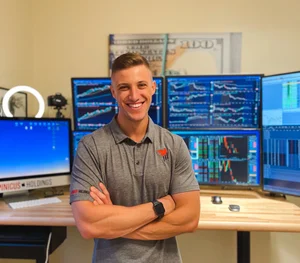
This is the approach behind AutoPilot Trader. Not a collection of indicators. Not a curve-fitted backtest. Kyle's actual 10-year trading framework, systematized and validated with rigorous methodology across 1,045 real backtested trades. The results: $306,405 in profit, 69.8% win rate, 3.58 Sharpe ratio. The kind of numbers that only come from a genuine edge, not parameter optimization.
With Kyle's course and mentorship, I couldn't be funded without him. I passed my first funded account as of July 25th 2024. - Desmond Young
What Real Algorithmic Edge Looks Like
Here's the thing most algorithm sellers won't tell you. A good-looking backtest is trivially easy to produce. Give someone a dataset, enough time, and enough parameters to tune, and they will find something that looks profitable. That's not evidence of edge. That's evidence of persistence.
Most traders confuse consistency with edge, or technical skill with edge. Before building or buying any automated system, it's worth understanding what a real trading edge actually is - because the same principles that apply to discretionary trading apply directly to building systems that last.
Real edge holds up when you:
Test on data the system has never seen (out-of-sample validation)
Run it through Monte Carlo simulation across thousands of randomly sampled scenarios
Check performance across different market regimes: trending, ranging, volatile, quiet
Account for realistic transaction costs including slippage and commissions
Verify the logic has a rational basis, not just 'these parameters worked in this dataset'
The AutoPilot Trader V3 NQ Long-Only strategy shows 100% profit probability across 1,000 Monte Carlo simulations. That's not a curve-fit. That's what genuine edge looks like when you put it through rigorous validation. The V3 complete analysis breaks down exactly how that methodology works, including how the same framework passes prop firm evaluations.
Most algorithms won't survive this kind of scrutiny. That's the point.
How to Evaluate Any Algorithmic Trading System
Before you trust any algorithm with real capital, run it through this framework. These are the same questions we work through with members in the Trader's Thinktank when evaluating systematic strategies.
Sharpe ratio. Most hedge funds target 1.0 to 2.0. Anything below 1.0 means the returns don't justify the volatility. Anything suspiciously above 3.5 in a short backtest should prompt hard questions about overfitting.
Profit factor. Gross profit divided by gross loss. Above 1.5 is a reasonable floor. Below 1.2 and transaction costs will eat your edge before it ever compounds.
Monte Carlo results. Run at minimum 500 simulations with randomized trade sequencing. If the system shows significant probability of catastrophic drawdown under random scenarios, that beautiful backtested equity curve is misleading.
Out-of-sample performance. Take the last 20-30% of your data and test it separately, untouched during development. How does it compare to in-sample results? A significant drop-off is a red flag you can't ignore.
Maximum drawdown. What's the worst-case loss from peak to trough in the backtest? Can you psychologically and financially survive that drawdown while staying in the system? Because you will experience it.
Logic audit. Why does this strategy work? If the answer is 'because these parameters optimized well historically,' that's not an answer. There should be a rational basis grounded in how markets actually behave - behavioral finance, liquidity dynamics, institutional order flow.
The Bottom Line
Trading algorithms aren't magic. They're not a shortcut around the fundamentals. The same edge that makes a discretionary trader profitable is what needs to be systematized in an algorithm. Automate randomness and you get automated losses. Automate a real edge with proper validation, and you've built something worth trading.
In our Trader's Thinktank community, we see this play out constantly. Traders come in having blown accounts on black-box systems that sounded compelling in a sales pitch. What they needed wasn't a bot. They needed to understand what edge actually looks like, how to validate it, and what it takes to execute it consistently -- whether manually or with automation.
Unlike other gurus who may focus on trying to sell you indicators, Kyle has a singular focus on helping his members execute, with an emphasis on simplicity and discipline. - EH
Whether you're building your own system or evaluating someone else's, that understanding is the foundation. The 10% of algorithms that work aren't lucky. They're disciplined, validated, and built on genuine edge.
The 90% that fail aren't unlucky. They're predictable. Now you know which category to avoid.
Trading futures involves substantial risk of loss and is not suitable for all investors. Past performance is not indicative of future results.