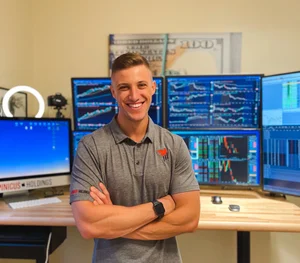
AutoPilot Trader vs QuantVue: Which Automated Futures Bot Is Right for You?
Author's Note: I built AutoPilot Trader. Full transparency: I have a financial interest in one of the products in this comparison. That said, this analysis uses publicly available data, and my goal is to help you make an informed decision, not sell you on something that doesn't fit.
Two futures automation tools are generating real conversation right now: AutoPilot Trader and QuantVue. Both are legitimate. Both have real users and verifiable track records. The question is not which one is "better" in some abstract sense. It's which one fits your trading goals.
QuantVue offers multiple algorithms, extensive customization, and a massive Discord community. AutoPilot Trader delivers a single proven strategy with white glove setup and the lowest drawdown I've seen in prop firm trading.
By the end of this breakdown, you'll know exactly which system matches your situation.
At a Glance: APT vs QuantVue
Algorithms: APT = 1 strategy, 2 modes | QuantVue = 6+ algorithms
Max Drawdown: APT = 2.61% (Long-Only) | QuantVue = 16.39% (Qkronos_EVO)
Win Rate: APT = 73.5% (Long-Only) | QuantVue = 64.59% (Qkronos_EVO)
Sharpe Ratio: APT = 4.05 | QuantVue = Not disclosed
Setup: APT = White glove, 35 min | QuantVue = Self-configured (not beginner friendly)
Instruments: APT = NQ, MNQ, YM, MYM | QuantVue = NQ, ES, YM, GC, CL+
First-Year Cost: APT = ~$6,200 | QuantVue = ~$10,000-10,500
Prop Firm Ready: APT = Yes (Long-Only mode) | QuantVue = Risky (16% drawdown)
Community: APT = Private (~250 users) | QuantVue = Discord (20,000+)
Trustpilot: APT = 4.8 stars (47 reviews) | QuantVue = 4.6 stars (259 reviews)
Quick takeaway: AutoPilot Trader is built for risk management and simplicity. QuantVue is built for flexibility and community-driven optimization. Both work. They're designed for different traders.
Pricing: Annual vs Lifetime
The headline numbers look simple. Factor in platform costs and the comparison shifts.
QuantVue Pricing Structure
Pro: Individual algorithm access
Elite: Multiple algorithm access
ATS (Full Automation): $9,000 lifetime -- includes done-for-you buildout and all algorithms
Additional required costs:
TradingView Premium: ~$60/month ($720/year)
Tradovate data fees: ~$20-30/month
VPS for 24/7 operation: ~$15-40/month
Total first-year cost for QuantVue ATS: $10,000-10,500
AutoPilot Trader Pricing
Annual license (current rate): $5,000/year -- all instruments and modes included
Annual license (at capacity): $7,997/year -- price increases as the 250-user cap approaches
Additional required costs:
TradingView Premium: ~$60/month ($720/year)
TradeForce execution platform: ~$40/month ($480/year)
Broker account (standard costs vary)
Total first-year cost for AutoPilot Trader: ~$6,200
Break-Even Analysis
Year 1: APT is roughly $4,000 cheaper than QuantVue.
APT: $6,200 ($5K license + $1,200 platform)
QuantVue: $10,000-10,500 ($9K + $1,000-1,500 platform)
Year 2 and beyond: QuantVue's lifetime model wins on total cost since you're only paying ongoing platform fees (~$1,000-1,500/year). APT continues at $6,200/year.
Break-even point: around 2 years. If you're committed long-term, QuantVue is more economical. If you want lower entry cost or aren't sure about a multi-year commitment, APT makes more sense to start.
Performance: The Numbers That Matter
Both systems show profitable backtests. The risk profiles are dramatically different.
Key Metrics Comparison
AutoPilot Trader - Long-Only Mode (NQ):
Win rate: 73.5%
Sharpe ratio: 4.05
Max drawdown: 2.61%
Backtested trades: 1,045
Profit probability: 100% (Monte Carlo tested)
Prop firm compatible: Yes
AutoPilot Trader - 2-Way Mode:
Win rate: 69.3%
Sharpe ratio: 3.73
Designed for personal accounts targeting maximum growth (not prop firm use)
QuantVue - Qkronos_EVO:
Win rate: 64.59%
Sharpe ratio: Not disclosed
Max drawdown: 16.39%
Backtested trades: 1,539
Profit probability: Not disclosed
Prop firm compatible: No (drawdown exceeds most firm limits)
Why Max Drawdown Is Everything for Prop Traders
Most prop firms fail you at 4-6% drawdown. Some examples:
FTMO: 5% daily loss limit, 10% max drawdown
TopstepTrader: 2-3% daily loss limit
Apex Trader Funding: 4% daily loss limit
QuantVue's Qkronos_EVO shows a 16.39% max drawdown. That number doesn't just breach the max drawdown limit at most firms. It would trigger daily loss limits multiple times during the descent. You'd lose your funded account before the drawdown even bottomed.
AutoPilot Trader's Long-Only mode shows 2.61% max drawdown across 1,045 trades. Even if you experienced 3x historical drawdown, you'd be at 7.83%, still within most prop firm parameters. That's the buffer you need when running automation on a funded account.
AutoPilot Trader just paid my rent for the month! - Desmond Young
The Sharpe Ratio Question
AutoPilot Trader discloses a 4.05 Sharpe ratio for the NQ Long-Only mode. Anything above 2.0 is considered strong. 4.0+ is exceptional. Most hedge funds target 1.0-2.0.
QuantVue doesn't publish Sharpe ratios. This matters. A high profit factor paired with massive drawdowns can produce solid absolute returns but terrible risk-adjusted performance. Sharpe ratio tells you if the risk is actually worth taking.
Transparency: Dashboard vs Screenshots
AutoPilot Trader provides an interactive dashboard showing:
Full equity curve with Monte Carlo confidence bands
Trade-by-trade results (all 1,045 trades)
Strategy breakdown by instrument and mode
P&L distribution histogram
100% profit probability (Monte Carlo tested)
QuantVue provides screenshots from TradingView backtests and requires users to run their own verification. Their marketing materials also state results are "hypothetical, selected after the fact," which is standard legal language worth understanding before you compare numbers.
Complexity: One Strategy vs Six+
This is where the philosophies diverge sharply.
QuantVue's Approach: Multiple Algorithms
QuantVue offers 6+ algorithms with different characteristics:
Qkronos_EVO: Momentum-based, 64.59% win rate
Qzeus: Counter-trend, ~73% win rate per documentation
Qice, Qgrid, Leongrid: Various market conditions
More algorithms in active development
Each algorithm has dozens of configurable settings: entry thresholds, stop loss levels, take profit targets, position sizing, and martingale options (doubling down after losses). Users must either learn and optimize each algorithm themselves, copy "proven" settings from the Discord community, or use the recommended J12 settings (which their docs note "requires significant management").
From QuantVue's own documentation: "Remember, whatever you pick you need to make a commitment to testing and learning. Do not strategy hop."
That quote tells you something. If the algorithms worked consistently, strategy hopping wouldn't need to be a documented problem.
AutoPilot Trader's Approach: One Strategy
One strategy, two modes:
Long-Only: For prop firm trading (4.05 Sharpe, 2.61% max drawdown)
2-Way: For personal accounts targeting maximum growth
Settings are preconfigured. No user optimization required. No martingale features. Same settings work across market conditions.
The strategy is built on the Two Hour Trader framework: market structure (higher highs/lows), volatility filters, momentum confirmation, and defined exits (breakeven, trailing stops). I've traded this framework for 10 years.
The Optimization Burden
QuantVue puts configuration work on you. That's not inherently bad. Some traders enjoy it. But if you're not statistically inclined or don't want to spend time optimizing parameters, QuantVue's flexibility can become overwhelming.
AutoPilot Trader removes the burden entirely. The strategy either fits your goals or it doesn't. That clarity is a feature, not a limitation.
Setup: White Glove vs DIY
How you get started differs dramatically -- and this is one of the most important distinctions between these two platforms.
QuantVue Setup Process
Purchase plan
Submit TradingView or NinjaTrader account details via post-purchase form
Access granted automatically to private indicators
Watch training video library
Join Discord community (20,000+ members)
Configure settings yourself or copy from community
ATS program includes a "done for you" buildout option
Support: Discord community, email support, training videos. Time to go live: 1 hour to several days depending on your experience and comfort level.
It's worth noting that QuantVue's own documentation explicitly states the platform is not beginner friendly. There's no personalized guidance during onboarding -- you're working from videos and community posts to figure out your own configuration. For experienced algo traders who enjoy that process, that's fine. For everyone else, it's a steep and frustrating learning curve.
I've spoken with traders who came from QuantVue and described the setup experience as one of their biggest pain points -- not because the platform is broken, but because there's no one walking you through it. You're on your own.
AutoPilot Trader Setup Process
Purchase license
Schedule 1-on-1 Zoom call with the PTG team
Our team personally configures your entire setup (~35 minutes)
You're fully operational before the call ends
Support: Community chat or direct message with the PTG team. Zoom calls as needed. Time to go live: 35 minutes.
The White Glove Difference
During the setup call, we personally configure your broker integration, set up execution routing, walk through exactly how the strategy works, and review the TradingView indicators with you.
You don't read documentation, figure out settings, or troubleshoot on your own. By the end of the call, you're operational.
QuantVue's community scales better with 20,000+ users and a large video library. But if you want hands-on support and immediate configuration without the DIY work, AutoPilot Trader removes all friction. The difference is especially significant if you're newer to automation or simply don't want to spend days learning a system before you can trade it.
Prop Firm Trading: A Critical Comparison
If you're using automation for prop firm evaluations, drawdown management is the entire conversation.
Why Most Prop Firms Fail Automated Traders
Prop firms typically enforce:
4-6% max drawdown before account failure
2-3% daily loss limits
Minimum 10-day challenge periods
Automated strategies with large drawdowns violate these rules quickly. Even if the strategy is profitable long-term, one bad week on a funded account ends your evaluation.
QuantVue's Drawdown Problem
Qkronos_EVO's 16.39% max drawdown creates three problems for prop traders:
You'd violate max drawdown rules at most prop firms
Daily loss limits would trigger multiple times during the drawdown
You'd need a massive account buffer to survive the full drawdown
Some traders report success using Qzeus (~73% win rate, lower drawdown per documentation). But QuantVue's marketed flagship strategy is incompatible with most funded account rules.
AutoPilot Trader's Prop Firm Mode
The Long-Only mode shows:
2.61% max drawdown (more than 6x lower than QuantVue's flagship)
73.52% win rate
4.05 Sharpe ratio
100% profit probability (Monte Carlo tested)
That drawdown profile leaves room for statistical variance, execution slippage, and the occasional user error, while staying well within most prop firm parameters. Many AutoPilot Trader users run it specifically on funded accounts because the drawdown is actually manageable.
Instrument Flexibility
This is one area where QuantVue has a clear edge.
QuantVue Instruments
NQ (Nasdaq-100)
ES (S&P 500)
YM (Dow Jones)
GC (Gold)
CL (Crude Oil)
And more
If you trade ES, gold, or crude oil, QuantVue is your only option between these two systems.
AutoPilot Trader Instruments
NQ (Nasdaq-100)
MNQ (Micro Nasdaq-100)
YM (Dow Jones)
MYM (Micro Dow)
Stock index futures only. The strategy is specifically optimized for index futures behavior. I don't offer instruments I haven't tested extensively with real capital.
Creator Backgrounds
Who built each system matters.
QuantVue Team
Founded by "former hedge fund developers and traders"
Large team supporting 20,000+ users
Multiple algorithms in active development
Focus on building a comprehensive trading platform
AutoPilot Trader Creator
Built by Kyle (professional day trader, 10+ years)
Based on the Two Hour Trader framework, taught to students since 2016
One-person operation with strategic broker partnerships
One proven strategy rather than multiple offerings
Neither background is inherently superior. QuantVue's team model allows faster development and scale. APT's single-creator model ensures consistency but limits scope.
Community and Support
QuantVue Community
20,000+ members in Discord
Active daily discussion
Members share settings, strategies, and results
Community-driven optimization
Standard email support
Pros: Large community, peer learning, active 24/7.
Cons: Signal-to-noise ratio issues, conflicting advice, can be overwhelming for beginners. No personalized onboarding -- you're self-directed from day one.
AutoPilot Trader Support
Direct message access to Kyle and the PTG team
1-on-1 Zoom calls as needed
Private community for all active users
Smaller user base (capped at ~250 to preserve edge)
Pros: Direct access to the creator, consistent guidance, intimate community with real accountability.
Cons: Smaller than QuantVue's Discord, less peer-to-peer activity.
Trust and Social Proof
QuantVue Reviews
Trustpilot: 4.6 stars (259 reviews)
More established user base with more review volume
Some reviews mention blown accounts despite following "proven" settings
AutoPilot Trader Reviews
Trustpilot: 4.8 stars (47 reviews)
Higher average rating, fewer reviews (smaller user base by design)
The 250-user cap limits total review volume. It also means fewer traders are simultaneously executing the same signals, which protects strategy performance from market impact.
With 20,000+ QuantVue users potentially running identical strategies, there's real potential for execution quality degradation over time as order flow converges.
Red Flags and Concerns
Let's be direct about the concerns with both systems.
Concerns About QuantVue
Performance disclaimers: Results are "hypothetical, selected after the fact." Standard legal language, but it means showcased results may not reflect typical user experience.
Martingale options: Some algorithms include the option to double position size after losses. This is a dangerous feature that can blow accounts during losing streaks. Its inclusion signals higher risk tolerance in the design philosophy.
Strategy hopping: QuantVue's docs warn users against it, implying it's a common problem. If the algorithms performed consistently, this wouldn't need to be addressed.
Not beginner friendly: QuantVue's own documentation acknowledges this. There's no personalized onboarding, no one walking you through your configuration, and the learning curve is real. If you're newer to automation, expect to spend significant time in training videos and Discord threads before you're comfortable going live.
Large user base: With 20,000+ users on the same strategies, simultaneous entries can degrade execution quality.
Concerns About AutoPilot Trader
No refund policy: $5,000 commitment with no trial period. That's a higher barrier than QuantVue's 30-day (Pro/Elite) or 120-day conditional (ATS) guarantees. The mitigation: full transparency upfront. The interactive dashboard shows all 1,045 trades, complete methodology, and Monte Carlo analysis before you spend a dollar. The goal is an informed decision going in.
Limited instruments: Only NQ, MNQ, YM, and MYM. If you trade ES, gold, or crude oil, AutoPilot Trader won't work for you.
Annual cost: $5,000/year adds up. After 2 years, total cost exceeds QuantVue's lifetime model. Long-term cost favors QuantVue.
User cap: Limited to 250 users. Price increases to $7,997/year as capacity fills.
The Bottom Line
Both AutoPilot Trader and QuantVue are legitimate automated trading tools. Neither is a scam. Both have real users, verifiable track records, and transparent creators.
Your choice depends entirely on your priorities.
Decision Framework
Choose AutoPilot Trader if:
You need prop firm compatible drawdown (under 4%)
You want white glove, zero-configuration setup
You prefer lower first-year cost
You want direct creator access and personalized support
You're newer to automation and want someone to hold your hand through setup
Choose QuantVue if:
You trade ES, gold, or crude oil futures
You want maximum algorithm flexibility and enjoy optimization
You prefer lifetime pricing (pays off after year 2)
You want a large peer community (20,000+ members)
You're an experienced algo trader comfortable with self-directed configuration
Final Recommendations
For prop firm traders: AutoPilot Trader is the clear choice. A 2.61% max drawdown vs 16.39% is not a close call when prop firms fail you at 4-6%. The Long-Only mode with a 4.05 Sharpe ratio was built specifically for funded account rules.
For traders wanting flexibility: QuantVue. More algorithms, more instruments, more customization. If you enjoy optimization and need to trade ES, gold, or crude oil, QuantVue gives you the tools.
For non-technical traders: AutoPilot Trader. The white glove setup removes all complexity. You don't choose settings, configure indicators, or troubleshoot. Fully operational in 35 minutes. QuantVue's own documentation explicitly warns it is not beginner friendly -- and that's not false modesty. There's no personalized guidance, and you're expected to self-configure from day one.
For budget-conscious traders: APT has lower first-year cost ($6.2K vs $10-10.5K). But QuantVue's lifetime model wins after about 2 years. Factor in your time horizon before deciding.
For community learners: QuantVue's 20,000-member Discord is unmatched for daily peer interaction and shared optimization.
Frequently Asked Questions
Is QuantVue or AutoPilot Trader better for prop firm trading?
AutoPilot Trader. The 2.61% max drawdown vs QuantVue's 16.39% is the deciding factor when most prop firms fail accounts at 4-6% drawdown. AutoPilot Trader's Long-Only mode is specifically built for funded account rules. QuantVue's flagship strategy (Qkronos_EVO) is generally incompatible with prop firm parameters.
How much does QuantVue cost compared to AutoPilot Trader?
QuantVue ATS: $9,000 one-time plus ~$1,000-1,500/year in platform costs. AutoPilot Trader: $5,000/year plus ~$1,200/year in platform costs. First-year cost: APT ~$6,200 vs QuantVue ~$10,000-10,500. Break-even occurs around year 2.
Does QuantVue offer a money-back guarantee?
QuantVue offers a 30-day money-back guarantee on Pro and Elite plans for first-time customers. The ATS program has a 120-day conditional guarantee with specific requirements. AutoPilot Trader does not offer refunds but provides complete backtest data transparency before purchase.
What is the win rate for QuantVue vs AutoPilot Trader?
AutoPilot Trader: 73.5% win rate (Long-Only mode), 69.3% (2-Way), across 1,045 backtested trades. QuantVue Qkronos_EVO: 64.59% win rate across 1,539 trades. Both are profitable. AutoPilot Trader has a higher win rate with significantly lower drawdown.
Which trading bot is easier to set up?
AutoPilot Trader - and it's not close. The PTG team personally configures your full setup on a 1-on-1 Zoom call. Time to go live: 35 minutes. QuantVue requires self-configuration using training videos or Discord community settings, and their own documentation explicitly states the platform is not beginner friendly. There is no personalized guidance during onboarding. For non-technical traders, the difference is significant.
Can I use both AutoPilot Trader and QuantVue simultaneously?
Yes, if you have separate accounts or sufficient capital to split positions. Running multiple automated strategies requires careful risk management and a clear understanding of potential signal conflicts.
Which system is better for someone new to futures trading?
AutoPilot Trader for complete beginners. White glove setup and preconfigured settings mean you don't need to understand optimization or choose between algorithms. QuantVue's documentation explicitly states it is not beginner friendly - and the self-directed onboarding process reflects that. Without personalized guidance, newer traders often find themselves spending days in Discord threads before they feel confident going live.
Risk Warning: Automated trading involves substantial risk of loss. Past performance does not guarantee future results. Trading futures and derivatives carries significant financial risk and may not be suitable for all investors.