How to Find a Trading Mentor in 2026 (Without Getting Scammed)
You've probably seen the pitch before. Some guy on YouTube with a Lambo in the thumbnail, talking about how he "made $50K last month" and is now offering to personally mentor you for the low, low price of $25,000.
Or maybe it's more subtle. A well-produced website. Real-sounding testimonials. A "curriculum" that looks legitimate. You pull out your credit card, and three months later you realize you learned nothing you couldn't have found on Investopedia for free.
Finding a real trading mentor in 2026 is harder than it should be. The space is flooded with people who discovered that teaching trading is more profitable than actually trading. And if you're new or frustrated or just trying to get better, that noise can be genuinely dangerous.
Let me walk you through what to look for, what to avoid, and why the best mentorship model most traders ignore is sitting right in front of them.
The Mentor Fantasy vs. the Mentor Reality
When most traders imagine finding a mentor, they picture something like an apprenticeship. A seasoned pro takes you under their wing, watches you trade in real time, corrects your mistakes, shares the exact setups they're using that week. You grow together. You eventually become good enough to trade on your own.
That picture isn't completely wrong. It does happen. But it's rare, and the version you can actually buy is almost never what it looks like in the fantasy.
Here's why the model breaks down in practice.
Real traders who are consistently profitable are busy trading. Their income comes from the market, not from selling courses. The window they have available to mentor someone is genuinely limited, and their time has real value attached to it. A trader clearing $200K a year can't spend three hours a day hand-holding a student for $500 a month. The math doesn't work.
So who is selling $500/month 1-on-1 mentorship packages at scale? Usually someone whose primary income is the mentorship itself.
That's not a rule. There are exceptions. But it's a useful filter.
Why Most 1-on-1 Mentorship Is Overpriced or Underdelivered
I've seen both sides of this. When I was building out PTG, I offered 1-on-1 coaching for years. I charged $7,497 for a reason: my time was genuinely valuable, and I wasn't going to dilute it by taking on 30 students at once. If I was going to help someone, I was going to actually help them.
But I also watched students pay premium prices to other "educators" and come away with nothing but a lighter bank account and a head full of conflicting indicators.
The problem with the 1-on-1 model at scale:
No accountability structure. One hour a week with a mentor doesn't build the daily habits that make a trader.
No community. You're trading in a vacuum, with feedback from one person who may or may not be trading themselves.
No live context. Reviewing recorded trades after the fact misses the psychological dimension entirely. The fear, the hesitation, the FOMO. Those things don't show up in a chart screenshot.
High cost with no proportional return. Most traders spend $3,000-10,000 on 1-on-1 programs and can't point to a clear skill improvement at the end.
I'm not saying 1-on-1 mentorship is worthless. I'm saying that for 95% of developing traders, there's a better model available at a fraction of the cost.
What to Actually Look For in a Trading Mentor
Before we get to the alternative, let's talk about evaluation. Whether you're looking at a 1-on-1 program or a group coaching structure, these are the filters that matter.
1. Do They Actually Trade?
This is the single most important question, and it's the one most people forget to ask.
Ask directly: "Can you show me a recent brokerage statement?" Watch how they respond. A real trader who's proud of their performance will either share it or explain why they can't (compliance, fund privacy, etc.) with a reasonable answer. Someone who pivots to talking about student success stories instead of their own results is telling you something.
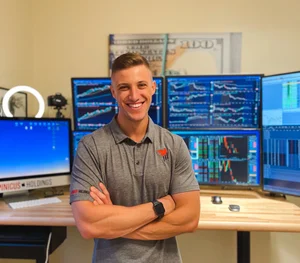
In our Trader's Thinktank community, Kyle trades live every single day on screen share. Members can watch him execute in real time, see the hesitations, see the stops, see the adjustments. That's a different standard than a pre-recorded course or a weekly Zoom where someone reviews charts that already closed.
2. What Are Their Teaching Credentials?
Being a great trader doesn't automatically make someone a great teacher. The best mentors have thought carefully about how people learn, not just what they know.
Look for:
A structured curriculum or progression (not just "watch me trade and ask questions")
Clear explanation of why not just what (understanding the logic behind setups matters more than memorizing patterns)
Track record of student outcomes, not just mentor outcomes
As Hatem put it after working with Kyle:
"Kyle is an excellent teacher who can convey concepts without making you feel stupid. I signed up 3 months ago and I feel that my trading has progressed years."
That's the bar. Progress that feels like years compressed into months. If you're paying for mentorship and you're not experiencing that, something is wrong.
3. Is There Accountability Built Into the Structure?
Knowledge transfer isn't enough. Traders fail not because they don't know what to do but because they can't make themselves do it consistently under pressure.
A good mentorship structure includes:
Regular check-ins with real feedback
A way to review actual trades (not just theories)
A community where you can see what success looks like from peers
Someone who will call you out when your reasoning is off
If the program is purely educational content with no accountability layer, it's a course with a premium price tag. Nothing wrong with courses. Just know what you're buying.
4. Are They Transparent About Losses?
Anyone selling mentorship who only talks about wins is either not trading or not being honest about what trading actually looks like.
Real trading involves drawdowns. Losing days. Setups that don't work. A mentor worth following talks about these openly and teaches you how to manage through them, not just how to celebrate the wins.
This is a big piece of what makes the group coaching model at PTG different. We run weekly trade reviews where the losses get the same attention as the winners. Sometimes more. Because that's where the real learning happens.
5. Can You Verify Student Results?
Testimonials are easy to fake. Screenshots are easy to edit. But a community with dozens of active members talking openly about their progress is harder to manufacture.
Look for:
TrustPilot reviews (third-party, harder to game)
Active community where you can ask current members directly
Specific, detailed results (not vague "changed my life" statements)
"Since being here I've had a much clearer understanding of when and where to trade. You've helped simplify my trading which has led to my first payout." - Martin Pena
First payout. Specific outcome. That's the kind of result that's hard to fake.
The Case for Group Coaching Over 1-on-1
Here's what I've learned after mentoring 100+ traders since 2017: the traders who improve the fastest aren't the ones who get the most 1-on-1 time. They're the ones who are most immersed in a high-quality trading environment.
Group coaching done right replicates the best parts of 1-on-1 mentorship at a fraction of the cost, while adding things 1-on-1 simply can't deliver.
What group coaching adds that 1-on-1 misses:
Real-time community feedback. When twenty traders are reviewing the same setup, you get perspective that a single mentor can't provide. One person sees the volume divergence you missed. Another flags the macro context. You learn faster from the collective.
Social proof of the process. Watching peers go through the same struggles you're in and come out the other side is more motivating than any lecture.
Normalized losses. When the whole community experiences a rough week together, it stops feeling like personal failure and starts feeling like market variance. That shift matters enormously for psychology.
Daily immersion. An hour a week with a 1-on-1 mentor is nothing compared to being in a live trading environment every single day with people who are serious about the craft.
One of our long-time members, Nick, put it this way after 15 years of trading:
"After trading for 15yrs, I wondered if I had reached my full potential. The Opinicus team helped optimize my trading to deliver the results I'm after."
Fifteen years of experience and he still found the group environment valuable enough to seek out. That tells you something.
How the Trader's Thinktank Works
I built the Trader's Thinktank because I wanted to create the mentorship experience I wish I'd had access to when I was learning.
Here's what members actually get:
Livestream trading every day. Kyle trades ES and NQ futures live on screen share from the open through the afternoon session. Members watch real decisions in real time.
Daily Premarket Prep. Every morning before the open, members get a written breakdown of the QQQ and NQ outlook, specific levels to watch, economic data for the day, and a game plan. Not vague analysis. Actionable levels.
Weekly group coaching calls. 90-minute live sessions where we dig into strategy, psychology, trade reviews, and Q&A. The recording library is over 100 hours and growing.
Daily session recaps. Each afternoon, members get a written recap of what happened and what to watch going into the next session.
A real community. Not a chatroom full of memes and signal spam. Professional traders sharing analysis, reviewing setups, and holding each other accountable.
The Two Hour Trader course is included free with membership. It's the exact framework Kyle uses in the live sessions, so you're not just watching someone else trade, you understand the logic behind every decision.
All of this for $70/month on the annual plan. Compare that to what a decent 1-on-1 package costs and the value becomes obvious quickly.
If you want to see how the Two Hour Trader strategy actually performs in practice, the results speak for themselves. For traders interested in automating that same strategy, AutoPilot Trader runs Kyle's exact methodology without requiring screen time.
The Bottom Line on Finding a Mentor
The mentor you're looking for probably isn't a $10,000 private coaching package. More likely, it's consistent immersion in a high-quality trading environment where a real trader shows up every day, shares their thinking transparently, and builds a community of people serious enough to hold each other accountable.
The checklist is simple:
Do they trade? Verify it.
Do they teach? Look at student outcomes, not just their own.
Is there accountability? Real structure or just content?
Are they honest about losses? Anyone only showing wins is hiding something.
Can you verify community results? Third-party reviews, real members you can talk to.
If a program clears all five, it's worth a serious look regardless of the format. If it doesn't, no amount of polish or testimonials should change your mind.
You're not just buying information. You're buying an environment. Make sure it's one where real traders show up every day ready to do the work alongside you.
That's what we've built. And it's what's changed the trajectory for over 100 members who were stuck before they found it.
Trading futures involves substantial risk of loss and is not suitable for all investors. Past performance is not indicative of future results.