What Is Day Trading? A Realistic Guide for New Traders
Most futures trading guides read like textbooks written by people who've never actually traded. They throw around terms like "intraday positions" and "closing before the bell" without explaining what any of it actually means when you're sitting in front of your trading platform at 9:30 AM Eastern with real money on the line.
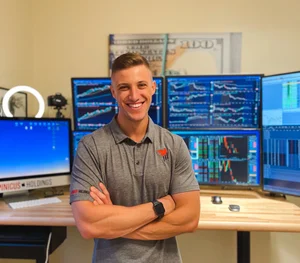
I've been day trading NQ and ES futures for over a decade. I've made millions in verified profits. I've trained over 100 traders. And I can tell you this with absolute certainty: what day trading actually is differs significantly from what most beginner content tells you.
Let me break down what day trading really means, how it works in practice, and whether it's right for you. No hype. No fear-mongering. Just the reality.
What Is Day Trading? (The Real Definition)
Day trading is opening and closing positions within the same trading day. You're not holding overnight. You're in, you're out, you move on.
That's the textbook definition. Here's what it actually means:
You're betting on short-term price movements. You're making decisions based on what's happening right now, not what might happen next quarter. You're focused on execution, entry timing, and risk management in a compressed timeframe.
I trade NQ futures. On a typical morning, I might enter at 9:35 AM, exit at 10:20 AM, and be done for the day. That's day trading. I'm not analyzing earnings reports or predicting Federal Reserve policy six months out. I'm reading price action, identifying high-probability setups, and executing.
The core principle: you profit from volatility and momentum, not from companies growing over time. You're trading market psychology and participant behavior, not fundamental business value.
This is why day trading requires a completely different skillset than long-term investing. Different tools. Different mindset. Different risk parameters.
How Day Trading Works (A Typical Day Explained)
Let me walk you through what a real day trading session looks like. Not the Hollywood version. The actual process.
8:30 AM ET: Pre-market Prep (15 minutes)
I'm scanning overnight price action. Where did NQ close? Any major news? What are the key levels from yesterday? I'm marking support and resistance on my charts.
This isn't hours of research. It's targeted preparation. In the Trader's Thinktank, our team posts daily pre-market analysis with exact trading levels. That's the kind of prep you need, not reading 47 articles about what the market might do.
9:30 AM ET: Market Open
I'm watching. Not trading yet. The first 5-10 minutes are chaotic. Algos are adjusting. Early participants are getting filled. I'm looking for the market to show its hand.
Amateur day traders rush in at 9:30:01. Professionals wait for confirmation.
9:40-10:30 AM ET: Prime Trading Window
This is where the action happens. The market has established direction. Volume is strong. Setups present themselves.
I'm looking for specific patterns. A pullback to a key level. A breakout with volume confirmation. A failed auction that reverses. These are the high-probability moments.
When I see my setup, I execute. My stop loss is predetermined. My profit targets are set. I'm not thinking, I'm following my system.
10:30 AM-12:00 PM ET: Done or Waiting
If I caught my move, I'm done. Off the platform. The Two Hour Trader methodology I developed focuses on this efficient approach. You don't need eight hours of screen time to be profitable. You need focused execution during the right windows.
If the setup never materialized, I didn't trade. That's also a successful day. Discipline beats activity.
This is what day trading actually looks like. It's not constant action. It's preparation, patience, and precision execution when the opportunity presents itself.
Day Trading vs Swing Trading vs Investing
Understanding the differences here is critical because people constantly confuse these approaches.
Day Trading:
Positions close same day. Focus on intraday price action and momentum. High frequency, smaller moves per trade. Requires active screen time during market hours. Capital can be redeployed daily with no overnight risk. Pattern Day Trader rule applies for stocks and options.
Swing Trading:
Positions held days to weeks. Focus on multi-day trends and chart patterns. Lower frequency, larger moves per trade. Less active management required. Capital tied up in positions overnight. Overnight gap risk.
Investing:
Positions held months to years. Focus on fundamental value and growth. Very low frequency, major moves over time. Minimal day-to-day attention needed. Capital committed for extended periods. Market cycle risk.
I day trade NQ futures. I'm not interested in what Tesla might do next quarter. I'm interested in what NQ is doing right now. That focus allows me to generate consistent returns without the stress of holding overnight positions through earnings reports or geopolitical events.
The two-hour window I trade generates enough opportunity. I don't need to swing trade or invest. But here's the key: you can do all three if your capital and time allow. They're not mutually exclusive. Many successful traders day trade for income and invest for long-term wealth building.
The mistake is treating day trading like investing. They require different skills, different psychology, and different time commitments.
The Pattern Day Trader Rule (What You Actually Need to Know)
If you're trading stocks or options with a margin account under $25,000, the PDT rule will affect you. Here's what matters:
The Rule:
If you make four or more day trades within five business days in a margin account, AND those day trades represent more than 6% of your total trades in that period, your account is flagged as a Pattern Day Trader. You must maintain $25,000 minimum equity.
How to Work Around It:
1. Futures don't have PDT restrictions. This is one reason I trade NQ. I started with a $10,000 account on micro futures. No PDT issues. Full day trading capability.
2. Cash accounts aren't subject to PDT, but you have T+2 settlement. Your buying power is limited to settled cash.
3. Just get to $25,000. The most straightforward solution. Save up. Paper trade until you have the capital. Don't rush into undercapitalized day trading.
This is why I recommend futures for day traders with smaller accounts. The leverage, flexibility, and lack of PDT restrictions make them ideal for learning the skill without artificial barriers.
How Much Money Do You Need to Start Day Trading?
Real talk here because most content either inflates or deflates this number to suit an agenda.
Minimum by Instrument:
Stocks/Options (margin account): $25,000 to avoid PDT restrictions. Realistically $30,000+ to handle volatility without getting margin-called.
Futures (standard contracts like NQ): $5,000-$10,000 absolute minimum. I recommend $15,000-$25,000. Standard NQ futures move $20 per point. A 10-point stop loss is $200. You need cushion for drawdowns.
Micro Futures (MNQ, MES): $2,000-$5,000 to start. Micro contracts are 1/10th the size of standard. This is where I tell new futures traders to begin. Build skill without major capital risk.
My Recommendation:
Start with the minimum viable capital for your chosen instrument, but only after:
1. Paper trading until you're consistently profitable for 60+ days
2. Understanding your strategy's win rate and average loss
3. Calculating proper position sizing
4. Having additional savings so trading losses don't affect your living situation
Don't rush into live trading. The market will still be here when you're ready. In the Trader's Thinktank, we require new members to demonstrate discipline in paper trading before jumping into live markets. That requirement saves people tens of thousands of dollars.
Day Trading Strategies That Actually Work
Let me be clear: there are thousands of day trading strategies. Most of them work for someone. The question isn't "does this strategy work?" but "will this strategy work for me given my risk tolerance, time availability, and psychological makeup?"
Here are the categories that consistently produce profitable day traders:
Trend Following
The market moves in waves. Trend following strategies identify the dominant direction and trade pullbacks within that trend. Simple. Effective. Harder than it sounds because human psychology wants to fight trends.
The Two Hour Trader Approach
The methodology I developed focuses on identifying the highest-probability 90-minute window after market open, executing one or two high-quality setups, and being done.
This isn't a specific pattern. It's a framework for efficient day trading. You learn to recognize the setups that have the best risk/reward in the most liquid market conditions. You trade them. You move on with your day.
I built The Two Hour Trader course to teach exactly this approach. It's 43 minutes of focused instruction on the one setup I trade most frequently. No fluff. No 47 different strategies. One proven approach you can implement immediately.
The point: pick a strategy category that aligns with your personality and time availability, then master it completely before expanding.
Common Day Trading Myths vs Reality
Myth: "90% of day traders lose money"
Reality: The statistics vary wildly depending on the study, the timeframe, and how "day trader" is defined. Many studies include people who tried day trading for three weeks with $500 and no education.
Yes, most unprepared day traders lose money. That's true of any skilled profession. Most people who try to do surgery without training would kill the patient. That doesn't mean surgery is impossible.
The real stat that matters: traders who commit to proper education, risk management, and psychological development have significantly higher success rates. In our Thinktank community, we see 62% average performance improvement among active members.
Myth: "You need to trade all day to make money"
False. Quality over quantity. I trade 90 minutes most days and generate consistent returns.
Myth: "Day trading is gambling"
Gambling is negative expected value. The house always wins long-term.
Trading is different expected value for different participants. Skill, edge, and discipline determine whether your expected value is positive or negative.
If you're trading randomly with no strategy, yes, it's gambling. If you're executing a tested, proven system with proper risk management, it's a skilled profession.
Kyle has changed my view on trading and made me not only the best trader I can be but also the best version of myself.
- Reece Davis
Tools and Platforms for Day Trading
You don't need much. Here's what actually matters:
Charting Platform:
TradingView (what I use), NinjaTrader (or Tradovate), ThinkorSwim, TradeStation. Pick one. Learn it completely. Don't platform-hop.
What You DON'T Need:
$5,000 indicator packages, "Professional" trading desks, Proprietary software from gurus, Complex algorithmic tools.
Keep it simple. Price action and volume tell you everything you need to know.
If you want to automate your strategy after mastering it manually, you'll need execution automation software. That's a different conversation for when you're consistently profitable.
Is Day Trading Right for You? (Honest Assessment)
Not everyone should day trade. Here's how to know if it's a fit:
You Might Be a Good Fit If:
You can handle emotional volatility without making impulsive decisions. You have capital you can afford to lose while learning. You can commit focused time during market hours. You enjoy pattern recognition and probability-based decision making. You can follow a system consistently even during losing streaks.
You're Probably NOT a Good Fit If:
You need guaranteed income from day one. You can't handle financial or psychological stress. You want passive income (that's automation, not manual day trading). You don't have time during prime market hours. You're looking for excitement or entertainment.
The Honest Truth:
Day trading is a skill. Like any skill, some people will master it faster than others. Some will struggle for years and never become consistently profitable. Some will achieve competency in 6-12 months with proper guidance.
The market doesn't care about your goals, your needs, or your effort. It only cares about execution. If you can't execute a proven system consistently, you won't succeed.
That's harsh. But it's reality.
The good news: if you can develop the skill, the rewards are substantial. Financial freedom. Time freedom. Scalability. The ability to generate income from anywhere with an internet connection.
I learned more from Kyle in one hour than I have from hours and hours of Youtube, reading articles, and taking courses from other groups.
- Mike
Where to Start
If you're serious about learning day trading:
1. Paper trade for 60 days minimum. No exceptions. Develop your strategy risk-free.
2. Learn one setup completely. Master one before expanding. The Two Hour Trader teaches the exact setup I've used for years. Forty-three minutes of instruction. One proven framework.
3. Find a professional community. Trading alone is significantly harder. In the Trader's Thinktank, you get daily live analysis, coaching, trade review, and accountability from traders who actually make money. That matters more than any course.
4. Start small. Micro futures. Small position sizes. Prove your edge with minimal capital before scaling.
5. Track everything. Every trade. Every emotion. Every mistake. Data drives improvement.
6. Be patient. This is a marathon, not a sprint. The market rewards consistency over years, not weeks.
Day trading is possible. It's profitable for those who develop the skill. But it requires realistic expectations, proper education, and disciplined execution.
Hello, World!
Stop consuming content. Start executing a plan.