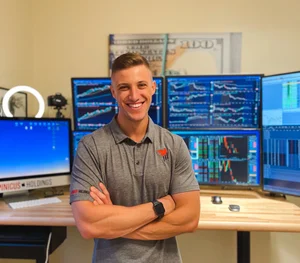
Copy Trading 80 Prop Accounts: Is It Actually Possible?
Last summer, five of my funded prop accounts got closed in a single afternoon.
I didn't blow them on a drawdown and I didn't fail an evaluation. The firm shut them down and flagged the accounts for hedging, because the copy trading software I was running had quietly put some of my follower accounts short while my lead account was long. Same prop firm, opposite directions, which is a bannable offense almost everywhere. It nearly killed an idea I'd spent months building.
This is the story of the copy trading software for prop accounts I actually use now, why the first two tools I tried failed in expensive ways, and how I'm scaling a group of funded accounts toward 80 plus without a single crossed trade. If you want to skip the story: I run all of it on Tradecopia. Use code OPINICUS for the best available discount, and there's a free trial if you want to test it before you commit.
I also break the whole thing down on video, including a live screen share of every account running at once. Watch the full breakdown here.
What a Prop Farm Actually Is, and Why You'd Copy Trade One
Let me back up, because copy trading prop accounts only makes sense once you understand what I'm building.
I run what I call a prop farm. That's a group of funded prop firm accounts, all copy trading from one lead account that I trade manually. I take a setup on my main account, and that single trade replicates across every connected funded account at once. One decision, proportional size on each.
Right now the farm is at 32 accounts. The target is 80 plus. Scaling like that is only possible if the copy trading layer is genuinely solid, because every account is real money with a real prop firm rulebook attached. One bad fill multiplied across 32 accounts isn't an inconvenience, it's 32 problems at the same time, and at some firms it's a compliance event that ends accounts.
That's the context for everything below. I'm not copy trading a couple of accounts as a hobby. I'm running a fleet, and the software has to behave exactly the same on account 32 as it does on account 1.
The First Two Tools I Tried, and Why They Both Failed
When I first set out to build the farm, around this time last year, I worked through the popular copy trading options.
The first was Replicanto. Good reputation in the space, but it's Windows only and, as far as I could tell, built for NinjaTrader 8. I don't trade on Windows and I don't use NinjaTrader, so that one was a dead end before I started.
The tool I actually committed to was TradeSyncer. Nothing against it as a product, plenty of traders run it without issue. It just did not mesh with the way I trade, and the way I trade is with limit orders.
The expensive part came next. Running limit orders through TradeSyncer, I kept hitting crossed trades. My main account would be long exactly as I intended, then I'd check the follower accounts and find some of them short. At that point you're not copy trading anymore, you're manually babysitting a dozen offside accounts and closing them out for an instant loss.
It got worse when crossed trades happened inside the same prop firm. Picture account A long and account B short, both at the same firm. To that firm's compliance system, that pattern is hedging, and hedging is grounds for closing accounts and sometimes banning the trader outright.
That's exactly what hit me. Five of my Take Profit Trader accounts were closed over crossed trades the copier created. To be fair to the firm, they were enforcing their own rules correctly, and the fault sat with the software, not the prop firm. It was still a brutal financial hit and a hard strike against the tool that caused it.
I spent months trying to make it work. The only consistent fix anyone could offer was switching to market orders. I don't trade market orders, and I wasn't going to rebuild my entire execution style to accommodate a copier. So late last summer I shelved the prop farm idea completely.
What Changed: the Software Runs Locally, Not in the Cloud
A few months later I found the tool I run now: Tradecopia. I've been on it for four to five months across the entire farm.
Tradecopia has one structural advantage the other copiers don't, and it's the entire reason this works. It runs locally on your machine. There's no cloud server your orders get routed through. TradeSyncer, by contrast, is cloud based, and that routing layer is precisely where my latency and crossed trade problems were coming from.
When there's no cloud hop between your lead account and your followers, two things change. Latency drops, because the order isn't taking a round trip to someone else's server before it reaches your other accounts. And in my experience the limit order problem simply disappears.
Let me put a number on it. In four to five months of running every trade as a limit order across the farm, I've had maybe two issues total, and neither one was a crossed trade. After what TradeSyncer cost me, that track record is the difference between a farm I can actually scale and an idea I had to walk away from.
The Tradecopia Features That Actually Matter
Tradecopia ships with a lot of features. Most of them I don't touch, so I'll focus on the handful that carry the farm.
Broker support. My accounts are mostly on Tradovate, which is the main broker platform I use to connect everything. Tradecopia also supports ProjectX, so Topstep accounts connect straight through there, and it recently added Rithmic, which I'm sampling now. Those three connection types cover most of the prop firm landscape I operate in.
Fractional and multiple position sizing. This is the setting I lean on hardest. You set a multiplier per follower account. If your lead account trades eight contracts and you want one follower trading four, you set a 0.5 multiplier. Want that follower trading sixteen on the same eight contract signal? Set it to 2x. Across a farm of different account sizes and rule sets, that per account control isn't a nice-to-have, it's the thing that makes running a fleet manageable at all.
Micro to mini conversion. Tradecopia can trade micros on your lead account and translate that into minis on a follower, or the reverse. When you're managing accounts of very different sizes, that one feature does more work than it sounds like it should.
Flatten controls. There are one-click flatten buttons for killing positions fast. I've personally never had to use them, but running 32 accounts, I sleep better knowing the insurance policy is sitting right there if a day ever goes sideways.
The Risk Management Tools, Even Though I Don't Use Them
Tradecopia also has a full risk management layer. You can set daily profit limits, daily loss limits, weekly profit and loss limits, and a hard trade count cap per account.
I'll be honest, I don't use any of it. Not because it's poorly built, it's actually well done. I rely on discipline rather than automated lockouts, and after enough years in the seat that's where my edge in self control lives.
If you're a developing trader who doesn't yet have ironclad impulse control, this layer is genuinely valuable. A daily loss lockout that closes the platform on you is a crude tool, and crude tools save accounts. If your real problem is that you keep trading after you swore you'd stop for the day, a hard limit you set that morning is worth more than another promise to yourself. That's a discipline gap, and I've written about how to close it in mastering trading discipline. The software guardrails buy you time while you build the real thing underneath.
That underlying work is also a big part of what we do inside the Trader's Thinktank. A tool can enforce a limit, but it can't hand you the judgment to know which limit is right for you in the first place. That part you have to learn.
Where This Fits if You're Running a Systematic Strategy
If you trade a systematic or automated strategy, copy trading prop accounts is where it gets genuinely interesting.
A defined strategy with consistent sizing is exactly the kind of thing that scales cleanly across a farm. One rule set, one lead signal, replicated across every funded account with the multiplier handling position sizing per firm. That's the same logic behind AutoPilot Trader, our automated execution of the Two Hour Trader framework on futures: systematic in, predictable out, across as many accounts as the copier can hold without crossing them.
We've had community members take this further and pass funded evaluations with an automated strategy running the show. I broke down a real example in how a trading bot passed a 50K prop firm evaluation in 18 days. Pair a strategy like that with a copier that doesn't cross trades, and you have a real path to scaling funded capital instead of just talking about it.
"After trading for 15yrs, I wondered if I had reached my full potential. The Opinicus team helped optimize my trading to deliver the results I'm after." - Nick Down
So Who Should Actually Use Copy Trading Software
Let me be direct about who this is for, because copy trading software is a scaling tool, not a shortcut.
It's the right tool if you already have a strategy that works on one account and you want that same edge running across many funded accounts at once. It earns its keep the moment you're building toward real prop firm scale, where execution has to behave identically whether it's account 1 or account 32. And it becomes close to essential if you trade a defined, systematic approach, because that's precisely the kind of signal that fans out cleanly with no manual babysitting.
It does not make sense if you don't yet have a profitable approach on a single account. Copy trading a losing strategy across 32 accounts doesn't fix the strategy, it just multiplies the leak by 32. The tool amplifies whatever you bring to it. Bring a real edge and you've got leverage. Bring an unsolved process problem and you've just built a faster way to discover it. If that's honestly where you are, the fix isn't a copier, it's the work laid out in how to stop losing money day trading.
"Unlike other groups focused on signals or watchlists, here you will learn to trade the market. To find your own identity as a trader." - Martin Chavez
That's the part no copier solves. Tradecopia replicates my decisions flawlessly, but it doesn't make the decisions. Building the underlying trading skill is still the work, and it's most of what we do in the Trader's Thinktank.
The Bottom Line
Building a prop farm came down to one unglamorous variable: whether the copy trading software could run my real execution style, limit orders included, across dozens of accounts without crossing a single one.
Two tools couldn't. Tradecopia can, and running it locally instead of through the cloud is the entire reason why. After four to five months and 32 live accounts, the track record makes the case better than I can.
If you're running prop accounts and want to try it, Tradecopia with code OPINICUS gets you the best available discount, and the free trial lets you test it on your own setup before you commit. That same code, OPINICUS, also gets the best pricing on the prop firms I build the farm on, TradeDay and Tradeify.
Next target is 80 plus accounts, which is going to be a real stress test for the software. I give live updates on the build during the daily livestream and walk through the full setup in the video above. If you want to watch the farm get built in real time, that's where it happens.
If you're earlier in the journey and the honest answer is that your strategy isn't there yet, start with the foundation instead. Time and a real process come before scale, and this breakdown of how long it actually takes to get consistently profitable is a more useful next click than any copier.