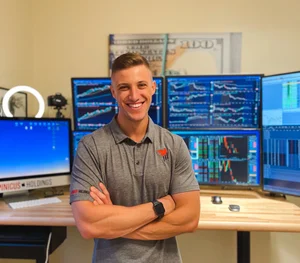
An Automated Trading System Changed How I Think About Edge
Three minutes before the FOMC announcement, I had my hand on the mouse.
The setup was there. Price was sitting right at a level I'd been watching all morning. My finger wanted to click. And I sat on it, because I'd already decided before I turned on my computer that Wednesday was a no-trade day.
That discipline, knowing which sessions work for you and which ones don't, is exactly the kind of edge that's nearly impossible to code into an algorithm. I spent five years learning that FOMC Wednesdays were statistically bad for my trading. Volatile, unpredictable, prone to trapping both sides. Eventually I stopped fighting it.
But here's what's interesting: the process of building AutoPilot Trader forced me to get brutally honest about which parts of my edge were real and which were just stories I told myself. That's what building an automated trading system actually does. It separates what you think you're doing from what you're actually doing.
What an Automated Trading System Actually Trades
Let's clear up some confusion before going further, because the internet has made "automated trading system" mean about twelve different things depending on where you look.
A genuine automated trading system executes trades based on a defined, rules-based logic without requiring you to click a button. It monitors the market, identifies when conditions match the setup criteria, and fires the order. The strategy is fixed. The emotion is removed.
What it does NOT do: it doesn't think, doesn't adapt on the fly to news events, doesn't "feel" when a trade looks off. That's important context, because most retail traders picture something smarter than what actually exists.
AutoPilot Trader runs one setup: a trend pullback to VWAP entry. That's it. The exact framework I've traded manually for over a decade, now automated. It doesn't select levels of interest, doesn't read chart patterns the way I do in real time, and doesn't make discretionary calls. It waits for a specific condition, enters when the condition is met, and manages the trade through defined profit targets and a trailing stop.
Simplicity is a feature, not a limitation. The most robust systems tend to be simple ones.
Why I Spent Years Resisting Automation
I want to be honest about something: I didn't build AutoPilot Trader because I thought automation was the future of trading. I built it because I got tired of watching the same setup play out correctly while I was in the middle of something else.
For years my trading was entirely discretionary. I was at the screen every morning, watching every bar, making every decision myself. And I was good at it. Still am. But there's a ceiling to what you can do manually, and that ceiling isn't about skill.
The ceiling is attention.
The Two Hour Trader framework targets the highest-probability two-hour window of the session. But the setup itself, that pullback to VWAP entry, doesn't always appear in that window. Sometimes it fires at 11:30. Sometimes at 1:15. And if you're not watching, you miss it. If you ARE watching for six hours straight, the quality of your decisions degrades.
I'd been manually trading this setup for years and keeping rough notes on results. The win rate was real. The edge was real. What wasn't sustainable was the execution model.
So in 2024 I started building the automation layer. What I expected to be a relatively quick project turned into a deep education in what I actually do when I trade.
The Backtest Moment That Changed Everything
Here's the transformation I wasn't expecting.
When you automate a strategy and run it against historical data, the system doesn't care about your narrative. It doesn't know that you "felt" the market was going to reverse that day, or that the news was weird, or that you had a gut feeling. It just applies the rules and records the outcome.
When I first backtested the Two Hour Trader setup across NQ futures, the results were better than I thought they'd be. Not because I was trading it wrong manually, but because manual execution introduces variability that erodes edge over time. Hesitation on valid signals. Overconfidence on lower-quality ones. Exiting early because the trade was already profitable and you didn't want to give it back.
The V3.3 backtest across roughly 17 months shows the NQ 2-Way strategy generating $358,990 across 604 trades at a 70.53% win rate with a 1.568 profit factor. The NQ Long-Only mode, built specifically for prop firm evaluations, backtested at 78.19% win rate with a 2.41 profit factor. Those are labeled backtests, not guaranteed future results. But they point at something real: the edge in the setup is measurable, and systematic execution captures more of it than discretionary execution does.
In 2026 the system has been running live, hands-free, with zero intervention. January was flat. February through May were green, with April being the high-water mark at +$19,327 net. The system ran untouched through a roughly $17,000 peak-to-trough drawdown in April without me touching a button. That's the behavioral pattern that separates systematic trading from discretionary trading: you wrote the rules when you were thinking clearly, and you let them run when emotions want to interfere.
If you want to dig into the specifics, the V3.3 analysis is here.
What Makes an Automated Trading System Worth Using
I get asked constantly what separates the trading bots that work from the ones that blow up accounts. After watching hundreds of traders in our Trader's Thinktank community try different approaches, I've noticed the same failure patterns.
The systems that fail share three characteristics:
They're curve-fitted. Someone found a parameter combination that worked perfectly on past data, then sold it as a system. When market conditions shift even slightly, the edge disappears because it was never real. It was just optimization noise.
They trade too frequently. High-frequency systems look impressive in backtests. They generate lots of data, which creates false statistical confidence. But for retail traders using standard execution infrastructure, the edge often evaporates once you account for commissions, slippage, and platform latency.
The developer doesn't trade it personally. This is the one that bothers me most. If the person selling the system isn't running it on their own account, that tells you everything you need to know about their actual confidence in it.
APT runs on my account. I experience every drawdown personally. When April went through a $17,000 pullback, I lived through it the same way every APT member did. That alignment matters. It's also why I'm honest about which months are flat and which ones are losses.
A member in our community put it well in a Trustpilot review:
"What I really appreciate is that Kyle personally trades the strategy himself, so he experiences both the good periods and the drawdowns right alongside everyone else."
- TheCrispyManTrades, verified Trustpilot review
That's not a marketing angle. It's just how I operate.
The Setup Doesn't Change. The Execution Does.
One thing I want to be clear about: automation doesn't replace understanding the market. It replaces the part of trading that humans are genuinely bad at: consistent, unemotional execution of a defined process.
The Two Hour Trader framework still requires you to understand market structure, trend context, and what a valid pullback looks like. That knowledge is what the Thinktank community builds in members over time. The automation handles the entry and exit mechanics once those conditions are present.
What I see in traders who use APT successfully is that the education component actually accelerates. When you can watch a system execute the setup hundreds of times without your hands on it, you start to see the pattern more clearly. You understand why a trade worked. You understand why it stopped out. The emotional noise is gone, so the learning happens faster.
Luis Ramirez shared this in our community after his first APT payout:
"I just got my first payout using APT. It's officially paid for itself, along with the money spent on the accounts themselves."
- Luis Ramirez
And from another member who'd been through the emotional grind of manual trading first:
"Just two days ago, I was down about $900. If I had interfered instead of trusting the system, I wouldn't be celebrating a payout today."
- TheCrispyManTrades
That second quote is the one I want you to read again. Down $900, trusted the rules, outcome reversed. That's what systematic trading looks like in practice. It's not comfortable in the moment. But it's what the data supports.
Who an Automated Trading System Makes Sense For
Not everyone should be using automation. Let me be direct about that.
If you're a developing trader who doesn't yet understand why a setup works, automating your entries won't fix the underlying gap. The system will execute correctly and you still won't know why you're winning or losing, which means you can't improve.
The Two Hour Trader course exists for this reason. It's 43 minutes of focused training on the exact setup APT automates. Understanding the setup manually first, even briefly, makes you a much better APT operator. You'll recognize valid conditions, understand when broader market context is unfavorable, and know when a drawdown is part of normal variance versus a signal that something's wrong.
Automation makes the most sense for traders who:
Have a real edge but struggle to execute it consistently
Are trading around a career and can't be glued to screens from 8:30 to 4:30 ET
Keep overriding their system because of intraday noise
Want to use prop firm evaluations but find the emotional pressure causes mistakes
For prop firm traders specifically, the Long-Only mode was built for evaluation environments. When you're constrained to one direction and execution quality matters more than signal frequency, a 78.19% win rate with a 2.41 profit factor gives you a meaningful edge over manual discretionary trading under pressure.
If you're evaluating prop firms, TradeDay and Tradeify are the two I work with directly. Use code OPINICUS on either for the best pricing.
The System Ran Through FOMC. I Didn't.
Back to that Wednesday morning.
I stayed in cash. I watched NQ approach my level, start to set up, then get whipsawed exactly the way I knew it could during Fed days. The discretionary version of me, the one from 2015, would have entered and gotten stopped out before the real move happened.
The automated system? It has its own rules around market conditions. It doesn't care that I was watching. It applied its criteria and stayed out.
Same outcome, different path. Mine came from ten years of learning that FOMC Wednesdays are statistically bad for this type of setup. The system's came from rules that account for session behavior.
That's the honest version of what an automated trading system is. Not a magic box. Not passive income with no thought required. A systematized version of a real edge, executing consistently so you don't have to be there for every bar.
The edge still has to be real. The rules still have to make sense. But if those conditions are met, systematic execution will capture more of that edge than you will on your own.
If you want to see what APT looks like before committing to the full system, every Thinktank member gets access to the APT Signals indicator. Same entry logic, same targets, manual execution. It's the closest thing to a trial run you'll find.
The full APT setup is here if you're ready to go deeper.